The Complete Apparel Sourcing Process for Global Fashion Brands
December 15, 2025
Apparel Sourcing 101: Key Terms Every Fashion Buyer Must Know
January 5, 2026
In this guide, you will learn:
How high-street retailers design apparel sourcing strategies that balance cost, speed, quality, and compliance at scale
How sourcing countries and suppliers are selected based on product category, lifecycle, and risk exposure rather than price alone
How leading retailers structure supplier portfolios, sourcing processes, and commercial terms to protect margin and delivery performance
How quality control, compliance, ESG, and risk management are embedded into sourcing governance, not treated as afterthoughts
How high-street sourcing organisations evolve from tactical buying to resilient, ecosystem-led sourcing models
Table of contents
(Click here to display)Hide- Section 1 - Executive Overview: Why Apparel Sourcing Defines High-Street Retail Performance
- Section 2: What “High-Street Retailer” Means in a Global Sourcing Context
- Section 3: Apparel Sourcing Strategy: From Tactics to Systems
- Section 4: Internal Sourcing Organisation Structure
- Section 5. Core Objectives of High-Street Apparel Sourcing
- Section 6. Product Lifecycle and Its Impact on Sourcing Decisions
- Section 7. Country Selection Strategy in High-Street Apparel Sourcing
- Section 8. Supplier Portfolio Design and Management
- Section 9. Supplier Selection Criteria
- Section 10. The High-Street Apparel Sourcing Process: Step by Step
- Section 11. Commercial Mechanics in High-Street Apparel Sourcing
- Section 12. Speed-to-Market and Lead Time Engineering
- Section 13. Quality Control Systems Used by High-Street Retailers
- Section 14. Compliance and Ethical Sourcing Frameworks
- Section 15. Sustainability and ESG Integration
- Section 16. Risk Management in Apparel Sourcing
- Section 17. Technology in High-Street Apparel Sourcing
- Section 18. Role of Apparel Sourcing Agents and Buying Offices
- Section 19. Cost Control and Margin Protection Strategies
- Section 20. KPIs and Performance Measurement in Sourcing
- Section 21. How High-Street Retailers Adjust Sourcing Strategy in Practice
- Section 22. Common Sourcing Mistakes Made by High-Street Retailers
- Section 23. Future Trends in High-Street Apparel Sourcing
- Section 24. Buyer-Focused Takeaways for High-Street Retail Leaders
- Section 25. How Professional Apparel Sourcing Partners Support High-Street Retailers
- Section 26. Final Strategic Summary: Building a Resilient High-Street Sourcing Ecosystem
Section 1 - Executive Overview: Why Apparel Sourcing Defines High-Street Retail Performance
What is apparel sourcing strategy in high-street retail?
Apparel sourcing strategy is the structured, repeatable system high-street retailers use to balance cost, speed, quality, and compliance across global supplier networks while delivering seasonal volume at target margins.
For high-street retailers, utilizing apparel sourcing company is not a support function. It is a profit engine and risk control mechanism. Decisions made at sourcing level directly determine gross margin, stock availability, markdown exposure, and reputational risk.
Unlike luxury or pure DTC brands, high-street retailers operate under three unforgiving constraints:
Large volumes with fixed retail price points
Short and rigid seasonal calendars
Public scrutiny on labour standards and sustainability
As a result, sourcing mistakes are amplified at scale. A single delayed shipment or compliance failure can cascade into lost sales, chargebacks, regulatory exposure, or negative press.
The CSC Triangle™: the non-negotiable trade-off
High-street sourcing decisions operate within the CSC Triangle™:
Cost | Speed | Compliance
Retailers can optimise two, but never all three simultaneously without strategic compromise.
Pushing cost too aggressively undermines quality or compliance
Chasing speed inflates cost or limits supplier choice
Over-engineering compliance reduces flexibility and increases lead time
Winning retailers do not eliminate this tension. They manage it deliberately through portfolio sourcing, disciplined processes, and supplier segmentation.
Why sourcing strategy matters more than ever
Several structural shifts have elevated sourcing to board-level relevance:
Margin compression from inflation and freight volatility
Shorter fashion cycles and higher SKU churn
Increasing regulatory pressure on supply chain transparency
Reduced tolerance for delivery failure by consumers
In this environment, ad-hoc buying decisions are no longer viable. High-street retailers that outperform peers treat sourcing as a system, not a series of negotiations.
SPEED COST COMPLIANCE Optimising any two dimensions places pressure on the third
Section 2: What “High-Street Retailer” Means in a Global Sourcing Context
Operational definition of a high-street retailer
A high-street retailer is defined less by geography and more by its operating model. Key characteristics include:
Mid-to-high volume apparel programs
Fixed retail price architecture
Seasonal and replenishment-based calendars
Predominantly private-label production
Examples range from value-led chains to premium high-street brands. What unites them is scale discipline rather than exclusivity.
High-street vs luxury vs DTC sourcing
High-street sourcing differs materially from other models:
| Dimension | High-Street | Luxury | DTC |
|---|---|---|---|
| Volume | High | Low to medium | Medium |
| Price flexibility | Low | High | Medium |
| Lead time tolerance | Low | High | Medium |
| Compliance scrutiny | Very high | High | Moderate |
| Supplier dependency | Distributed | Concentrated | Mixed |
High-street retailers cannot rely on storytelling or pricing elasticity to absorb inefficiencies. Sourcing must work at first principles level.
The private-label reality
Most high-street retailers source 70 to 95 percent of their assortment as private label. This creates:
Full responsibility for compliance and quality
Direct exposure to supplier failure
Greater leverage but higher accountability
As private label expands, sourcing teams effectively become manufacturing orchestrators rather than buyers.
Section 3: Apparel Sourcing Strategy: From Tactics to Systems
What sourcing strategy actually means
A sourcing strategy is not a country list or a preferred supplier spreadsheet.
A true sourcing strategy defines:
Where products should be made
By whom
Under what commercial rules
With what level of risk concentration
Over what time horizon
It converts business objectives into repeatable sourcing decisions.
Tactical sourcing vs strategic sourcing
Many retailers confuse activity with strategy.
Tactical sourcing
RFQ driven
Price focused
Reactive to seasonal pressure
Vendor switching without performance memory
Strategic sourcing
Portfolio based
Data informed
Calendar aligned
Performance measured longitudinally
Retailers stuck in tactical sourcing typically experience:
Chronic late deliveries
Rising compliance costs
Supplier fatigue
Margin leakage
The Retail Sourcing Maturity Curve™
High-street retailers evolve through five identifiable stages:
Price-led sourcing
Lowest cost wins. High volatility and frequent failure.Country-led sourcing
Country expertise develops. Risk still concentrated.Supplier-led sourcing
Core factories stabilise volume and quality.Portfolio-led sourcing
Suppliers assigned roles across categories and calendars.Ecosystem-led sourcing
Integrated planning, technology, compliance, and risk governance.
Only retailers operating at stages 4 and 5 consistently protect margin while scaling.
Section 4: Internal Sourcing Organisation Structure
How high-street sourcing teams are structured
Most mature high-street retailers operate a layered sourcing organisation:
Head of Sourcing or Supply Chain Director
Category sourcing managers
Regional sourcing offices or buying offices
Technical, quality, and compliance teams
The key distinction is decision authority. Strategic decisions remain centralised. Execution is regionalised.
Role clarity inside the sourcing function
Misalignment between functions is a common failure point.
Merchandising drives volume and price architecture
Design drives complexity and materials
Sourcing translates both into manufacturable reality
When sourcing is subordinated to buying or design, feasibility suffers. Best-in-class retailers give sourcing veto power on manufacturability and risk.
In-house sourcing vs external partners
Retailers choose between:
Fully in-house sourcing teams
Hybrid models with regional agents
The choice is rarely binary. Most retailers operate hybrids depending on:
Category complexity
Country risk
Internal capability maturity
Section 5. Core Objectives of High-Street Apparel Sourcing
Objective 1: Margin protection
Retail price points are largely fixed before sourcing begins. Cost overruns directly erode profit.
Sourcing teams protect margin by:
Engineering cost during design feasibility
Aggregating volume across suppliers
Locking commercial terms early
Objective 2: Calendar adherence
Late product is often worse than no product.
Missed deliveries lead to:
Markdown exposure
Lost full-price selling weeks
Distorted stock profiles
Speed discipline is therefore a sourcing responsibility, not just logistics.
Objective 3: Scalability and reliability
High-street growth depends on suppliers that can:
Absorb volume spikes
Maintain quality under pressure
Scale without operational breakdown
Cheap capacity that cannot scale is a false economy.
Objective 4: Risk and reputation control
Compliance failure is existential for high-street brands.
Sourcing teams are responsible for:
Audit readiness
Corrective action enforcement
Risk avoidance is not conservative. It is commercial necessity.
Section 6. Product Lifecycle and Its Impact on Sourcing Decisions
Why product lifecycle dictates sourcing strategy
Not all products should be sourced the same way.
High-street assortments typically include:
Basics with predictable demand
Seasonal core products
Fashion-forward items
Test and react programs
Each lifecycle demands different sourcing decisions.
Basics and repeat programs
Characteristics:
Long life
High volume
Cost sensitivity
Sourcing approach:
Long-term supplier relationships
Fabric aggregation
Stable production planning
Seasonal core products
Characteristics:
Medium volume
Defined selling window
Sourcing approach:
Balanced cost and speed
Reliable compliance footprint
Predictable lead times
Fashion-forward and test styles
Characteristics:
Low initial volume
High uncertainty
Sourcing approach:
Flexible suppliers
Shorter lead times
Willingness to absorb higher cost
Treating all categories identically is one of the most common sourcing mistakes.
Section 7. Country Selection Strategy in High-Street Apparel Sourcing
What is country selection in apparel sourcing?
Country selection is the structured evaluation process high-street retailers use to determine where specific product categories should be manufactured, based on cost structure, capability, capacity, lead time, and risk.
This is not a static decision. It is category-specific, calendar-driven, and risk-adjusted.
Retailers that rely on a single “preferred country” approach expose themselves to systemic failure when conditions change.
Core variables that drive country selection
High-street retailers typically evaluate sourcing countries across five dimensions:
Cost structure
Labour cost, productivity, overheads, duty, and logisticsCapability
Fabric access, machinery, technical skill, and complexity handlingCapacity depth
Number of scalable factories, not just headline capacityLead time performance
Fabric availability, port efficiency, and production velocityRisk profile
Political stability, FX volatility, compliance maturity
No country optimises all five simultaneously.
Category-led country selection
Leading retailers align countries to product categories rather than spreading categories indiscriminately.
Typical high-street alignment
Bangladesh:
Core basics, high-volume programs, price-sensitive stylesChina:
Speed-driven replenishment, complex constructions, short runsVietnam:
Consistency, structured programs, stable quality executionIndia:
Flexibility, embroidery, natural fibres, mid-volume programsTurkey / Eastern Europe:
Fast fashion, nearshoring, reactive replenishment
This category-country alignment is a cornerstone of portfolio sourcing.
Nearshoring vs offshore sourcing
Nearshoring is not a replacement for offshore sourcing. It is a strategic complement.
Retailers use nearshoring to:
Reduce markdown exposure
Support in-season trading
Hedge long lead-time risk
Offshore sourcing remains essential for:
Margin protection
Volume scalability
High-performing sourcing strategies intentionally mix both.
Buyer checklist: country selection readiness
Does the country match product complexity and volume?
Are lead times compatible with the retail calendar?
Is compliance infrastructure mature and credible?
Is political and FX risk acceptable for the season?
Section 8. Supplier Portfolio Design and Management
Why supplier portfolio design matters
High-street sourcing failures rarely stem from a single bad factory. They stem from poor portfolio design.
Over-concentration creates dependency risk. Over-diversification destroys leverage and consistency.
Portfolio design balances both.
The 4P Supplier Portfolio Model™
High-street retailers segment suppliers into four functional roles:
Primary suppliers
Core volume, repeat programs, margin-criticalProtective suppliers
Backup capacity, risk mitigation, surge handlingProgressive suppliers
Innovation, sustainability, technical advancementPeripheral suppliers
Test styles, fashion-forward, low commitment
Each supplier is assigned a role. Not all suppliers should be treated equally.
Strategic vs transactional suppliers
Strategic suppliers:
Receive forecast visibility
Participate in early development
Deliver consistent performance
Transactional suppliers:
Used opportunistically
Limited exposure
Easily replaceable
Confusing the two creates unrealistic expectations and operational friction.
Vendor consolidation logic
High-street retailers consolidate suppliers to:
Increase volume leverage
Improve compliance governance
Reduce complexity
However, consolidation must stop short of dependency.
Best practice:
No single supplier exceeds a defined percentage of category volume
At least one qualified backup for every critical program
PRIMARY Core volume PROGRESSIVE Innovation PROTECTIVE Risk hedge PERIPHERAL Test & fashion
Section 9. Supplier Selection Criteria
What high-street retailers actually evaluate
Supplier selection goes far beyond quoted price.
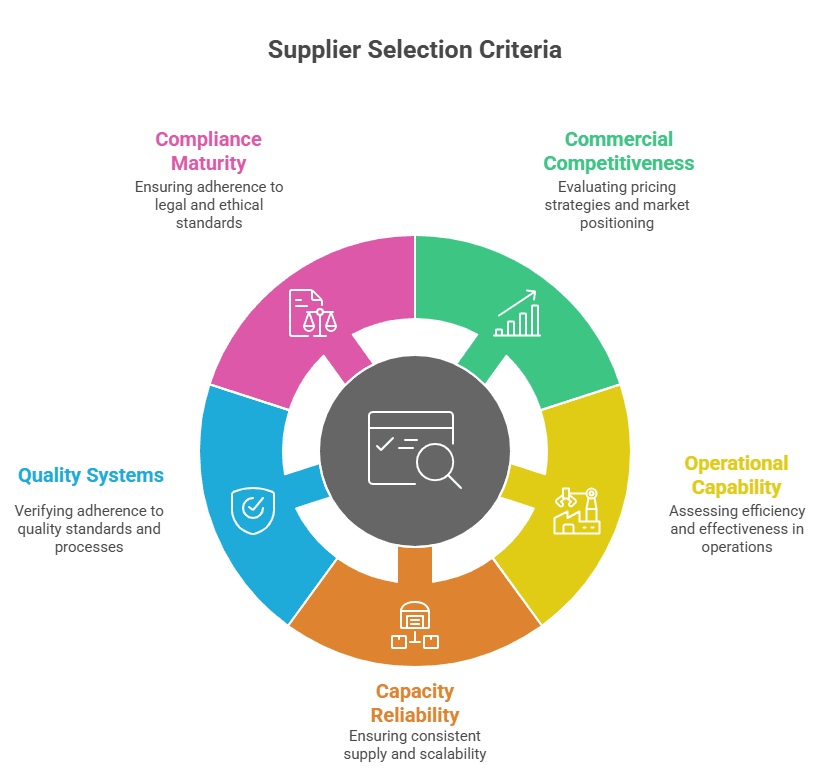
Leading retailers assess suppliers across five domains:
Commercial competitiveness
Operational capability
Capacity reliability
Quality systems
Compliance maturity
Price is a filter, not the decision.
Commercial evaluation
Retailers examine:
Cost breakdown transparency
Margin stability across volume bands
Willingness to commit to long-term pricing
Unwillingness to share cost structure is a red flag.
Technical and operational capability
Evaluation includes:
Machinery suitability
Technical team competence
Pattern and sample accuracy
Fabric and trim handling
Factories that outsource critical processes increase risk.
Capacity and booking discipline
Capacity is meaningless without discipline.
Retailers test:
Peak season booking accuracy
Historical overbooking behaviour
Contingency capacity availability
Over-promising is the most common supplier failure mode.
Financial stability
Retailers increasingly assess:
Liquidity risk
Dependency on single buyers
Ability to fund raw material procurement
Financially fragile factories amplify supply chain risk.
Buyer checklist: supplier approval
Factory capacity aligned with seasonal volume
QA and compliance systems operational
Financial stability verified
Historical OTD performance validated
Section 10. The High-Street Apparel Sourcing Process: Step by Step
Step 1: Tech pack readiness and feasibility
Sourcing failure often begins with poor inputs.
Before RFQs:
Specifications must be frozen
Fabric intent must be clear
Construction complexity must be realistic
Sourcing teams increasingly reject incomplete tech packs to protect downstream execution.
Step 2: RFQ issuance and comparison
RFQs are issued to:
Approved suppliers within the relevant country-category pool
Comparison focuses on:
Total landed cost
Lead time
Commercial terms
Risk exposure
Lowest price without feasibility validation is rejected.
Step 3: Cost engineering and negotiation
High-street retailers negotiate:
Fabric substitution
Construction simplification
Volume aggregation
Negotiation is collaborative, not adversarial, in strategic relationships.
Step 4: Sampling and approvals
Sampling stages include:
Proto
Fit
Size set
Pre-production sample
Delays at this stage compress production windows and create downstream chaos.
Step 5: Order placement and booking
Before PO release:
Fabric must be approved or booked
Capacity must be reserved
QC plan must be agreed
Order placement without these safeguards transfers risk from retailer to supplier, often unsuccessfully.
Buyer checklist: order placement readiness
Tech pack frozen
Fabric approved and booked
Capacity confirmed
QC checkpoints defined
Commercial terms locked
Section 11. Commercial Mechanics in High-Street Apparel Sourcing
Why commercial mechanics matter
Commercial terms determine who carries risk when things go wrong.
Retailers that neglect this pay for it later through claims disputes and margin erosion.
Incoterms and delivery responsibility
High-street retailers typically use:
FOB for control and cost transparency
Occasionally CIF for simplicity
DDP is rare due to margin and compliance implications.
Payment terms
Common structures include:
Letter of Credit (LC) for volume programs
Telegraphic Transfer (TT) for trusted suppliers
Deferred payment for strategic partners
Payment structure influences:
Supplier cash flow
Production commitment
Negotiating leverage
Chargebacks, claims, and penalties
Retailers define penalties for:
Late delivery
Quality failure
Compliance breach
However, excessive penalties without partnership erode supplier motivation and transparency.
Cost escalation and margin protection
Retailers increasingly include:
Raw material price adjustment clauses
FX risk sharing mechanisms
Volume-linked pricing tiers
These mechanisms stabilise long-term supplier relationships.
Section 12. Speed-to-Market and Lead Time Engineering
Why speed is a sourcing discipline, not a logistics problem
High-street retailers do not lose margin because products are expensive. They lose margin because products arrive late.
Late delivery compresses full-price selling windows, forces markdowns, and distorts inventory flow. Speed-to-market is therefore a commercial sourcing responsibility, not merely a freight or logistics concern.
Understanding the high-street critical path
A typical high-street critical path includes:
Design freeze
Fabric confirmation
Sampling and approvals
Production booking
Manufacturing
Inspection and shipment
Delays at early stages cascade exponentially downstream.
The High-Street Critical Path Compression Map™
Retailers that outperform peers actively compress lead time at specific pressure points:
Design freeze discipline
Late design changes are the single biggest cause of downstream failure.Fabric strategy
Pre-booked greige fabric and nominated mills reduce uncertainty.Sampling parallelisation
Overlapping sampling and material approvals where risk allows.Capacity pre-allocation
Booking production slots before final PO issuance.
Speed vs cost trade-offs
Retailers often misinterpret speed as a logistics decision. In reality:
Air freight is a symptom, not a solution
Speed must be engineered upstream
Strategic speed is cheaper than reactive speed.
Section 13. Quality Control Systems Used by High-Street Retailers
Why quality failures are sourcing failures
Quality problems are rarely manufacturing surprises. They are sourcing and governance failures.
High-street retailers operate at volumes where even small defect rates translate into material financial loss.
The multi-layer QC model
Best practice high-street QC systems operate across three stages:
Inline inspection
Identifies process issues before volume accumulation.Midline inspection
Validates consistency at scale.Final inspection
Confirms shipment readiness against agreed AQL.
Relying solely on final inspection is a high-risk strategy.
AQL standards and defect classification
High-street retailers typically apply:
AQL 2.5 for major defects
AQL 4.0 for minor defects
Defects are classified as:
Critical
Major
Minor
Clear defect taxonomy prevents subjective disputes.
Root cause analysis and corrective action
High-performing sourcing teams enforce:
Defect trend analysis
Corrective and preventive action (CAPA)
Supplier accountability for recurrence
Quality improvement is iterative, not punitive.
Buyer checklist: QC system adequacy
Are inspection stages clearly defined?
Are defect standards unambiguous?
Is root cause analysis mandatory?
Are repeat failures tracked longitudinally?
Section 14. Compliance and Ethical Sourcing Frameworks
Why compliance is existential for high-street retailers
Unlike niche brands, high-street retailers operate under:
Media scrutiny
NGO oversight
Regulatory exposure
A single compliance failure can trigger brand-wide consequences.
Common compliance standards
High-street retailers typically require compliance with:
SMETA (Sedex)
BSCI
WRAP
Local labour law frameworks
Audits cover:
Labour standards
Health and safety
Wages and working hours
Fire and building safety
Social vs technical compliance
Social compliance focuses on labour conditions.
Technical compliance addresses building, electrical, and fire safety.
Both are non-negotiable.
Audit fatigue and rationalisation
Retailers increasingly rationalise audits by:
Shared audit platforms
Risk-based audit frequency
This reduces factory burden while maintaining standards.
Section 15. Sustainability and ESG Integration
ESG as a sourcing gatekeeper
For high-street retailers, ESG is no longer a marketing initiative. It is a commercial requirement.
Retailers face:
Mandatory disclosure regulations
Investor scrutiny
Consumer activism
Sourcing teams are on the frontline of ESG delivery.
Sustainable material sourcing
Key focus areas include:
Organic and recycled fibres
Traceable raw materials
Reduced chemical usage
Material choice now influences supplier eligibility.
Environmental impact management
Retailers increasingly track:
Water consumption
Energy usage
Chemical compliance (RSL, MRSL)
Suppliers unable to provide data lose competitiveness.
Greenwashing risk
Unverified sustainability claims expose retailers to legal and reputational risk.
Best practice:
Third-party verification
Measurable KPIs
Transparent reporting
Section 16. Risk Management in Apparel Sourcing
Understanding sourcing risk holistically
High-street sourcing risk extends beyond cost and delivery.
Key risk categories include:
Country risk
Supplier dependency
Capacity volatility
Compliance failure
Financial instability
Portfolio-based risk mitigation
Retailers mitigate risk by:
Multi-country sourcing
Backup suppliers
Volume caps per factory
Staggered production schedules
Risk is managed structurally, not reactively.
Crisis response readiness
Retailers that weather disruptions best have:
Pre-approved alternative suppliers
Flexible capacity agreements
Clear escalation protocols
Crisis planning is part of sourcing governance.
Section 17. Technology in High-Street Apparel Sourcing
Why technology adoption matters
Manual sourcing processes do not scale.
High-street retailers increasingly rely on technology to:
Improve visibility
Reduce errors
Accelerate decision-making
PLM and sourcing platforms
PLM systems support:
Tech pack management
Sample tracking
Supplier communication
Critical path monitoring
Integrated platforms reduce silos between design, sourcing, and production.
Digital sampling and 3D design
3D sampling enables:
Faster approvals
Reduced physical samples
Lower development cost
Adoption is accelerating but uneven across categories.
Data-driven sourcing decisions
Advanced retailers use data to:
Track supplier performance
Predict delays
Optimise allocation across portfolios
Technology enables sourcing maturity, but does not replace judgement.
Section 18. Role of Apparel Sourcing Agents and Buying Offices
Why sourcing agents still exist in mature retail organisations
Despite large in-house sourcing teams, high-street retailers continue to use sourcing agents and regional buying offices. This is not a capability failure. It is an economic and risk-management decision.
Agents are typically used where:
Geographic distance increases execution risk
Volume concentration demands local oversight
Compliance enforcement requires continuous presence
Internal teams lack deep regional expertise
What sourcing agents actually do
At an operational level, agents provide:
Factory identification and vetting
Price benchmarking and cost engineering
Production follow-up and escalation
Quality and compliance coordination
At a strategic level, effective agents act as risk buffers, absorbing volatility that internal teams cannot manage remotely.
Regional buying offices vs third-party agents
Retailers choose between:
Owned regional buying offices
Independent sourcing agents
Owned offices offer control but carry fixed overhead. Agents offer flexibility but require governance.
Most retailers use a hybrid model, selecting the structure by country and category.
When agents add the most value
Agents are most valuable when:
Sourcing in high-volume, high-risk markets
Managing fragmented supplier bases
Scaling rapidly without internal headcount expansion
Section 19. Cost Control and Margin Protection Strategies
Why cost control starts before RFQs
High-street margins are largely determined before sourcing begins.
Retailers that attempt to negotiate margin at RFQ stage alone typically fail.
Should-cost modelling
Advanced sourcing teams use should-cost models to:
Understand true cost drivers
Identify unrealistic quotes
Support informed negotiation
This shifts discussions from price to structure.
Fabric and trim aggregation
Cost savings are achieved by:
Aggregating fabric across styles and seasons
Nominating mills
Locking volume-based pricing
This reduces volatility and improves forecasting.
Volume leverage and long-term pricing
Retailers protect margin by:
Offering volume commitments
Using tiered pricing structures
Aligning price with forecast accuracy
Short-term opportunistic buying erodes long-term leverage.
Inflation and volatility management
Retailers increasingly adopt:
Indexed pricing clauses
FX risk sharing mechanisms
Material escalation thresholds
These stabilise supplier relationships during market shocks.
Section 20. KPIs and Performance Measurement in Sourcing
Why KPIs drive sourcing behaviour
What gets measured gets managed.
High-street sourcing KPIs determine:
Supplier allocation decisions
Internal accountability
Strategic sourcing direction
Poor KPIs encourage short-termism and blame shifting.
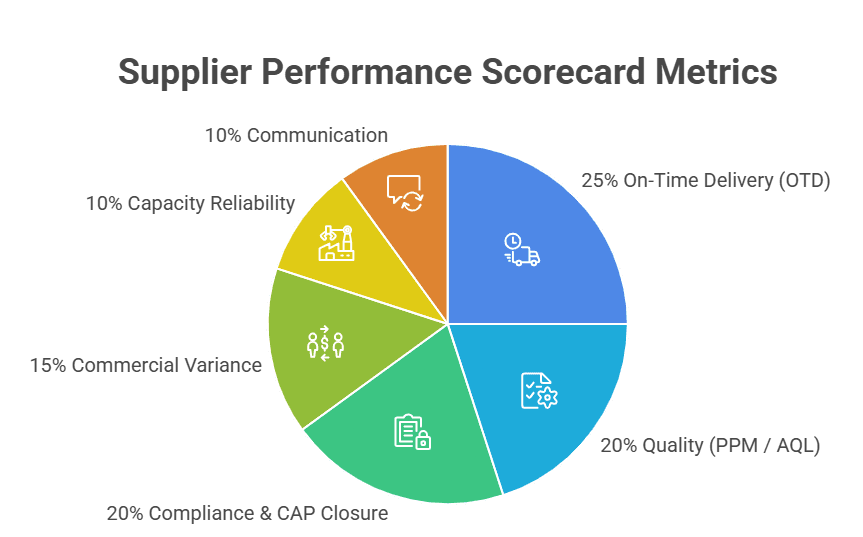
Core sourcing KPIs
Leading retailers track:
On-time delivery (OTD)
Quality rejection and PPM
Compliance audit scores
Cost variance vs RFQ
Capacity booking accuracy
KPIs are tracked longitudinally, not season by season.
Supplier performance scorecard
Retailers increasingly use weighted scorecards to guide volume allocation and supplier development.
Performance drives future opportunity.
Governance cadence
Best practice includes:
Quarterly supplier reviews
Annual strategic supplier assessments
Clear escalation thresholds
Governance prevents surprises.
Section 21. How High-Street Retailers Adjust Sourcing Strategy in Practice
Scenario 1: Inflation shock
Retailers respond by:
Rebalancing country mix
Increasing nearshoring for select categories
Renegotiating volume commitments
Scenario 2: Supply chain disruption
Effective responses include:
Activating backup suppliers
Re-prioritising core programs
Temporarily reducing SKU count
Retailers without contingency plans absorb disproportionate damage.
Scenario 3: Rapid growth
Growth strains sourcing systems.
Retailers that scale successfully:
Expand supplier portfolios deliberately
Invest early in governance
Avoid overloading core factories
Section 22. Common Sourcing Mistakes Made by High-Street Retailers
Over-indexing on price
Lowest price sourcing often results in:
Quality failure
Delivery delays
Hidden compliance risk
Price without feasibility is not savings.
Poor tech pack discipline
Incomplete specifications cause:
Sampling delays
Cost escalation
Misaligned expectations
Sourcing cannot compensate for weak inputs.
Over-consolidation
Excessive reliance on few suppliers increases systemic risk.
Resilience requires controlled redundancy.
Treating compliance as a checkbox
Audit pass does not equal ethical sourcing.
Compliance must be continuously enforced.
Section 23. Future Trends in High-Street Apparel Sourcing
Structural trends shaping the next decade
High-street sourcing is evolving toward:
Nearshoring acceleration
Digital sampling normalisation
Supplier consolidation with governance
ESG as a sourcing gatekeeper
Technology-enabled decision making
AI and advanced analytics will increasingly support:
Demand forecasting
Supplier allocation
Risk prediction
Human judgement remains central, but better informed.
The future sourcing leader
Future sourcing leaders will be:
Data-literate
Risk-aware
Commercially fluent
ESG competent
Sourcing is becoming a strategic leadership function.
Section 24. Buyer-Focused Takeaways for High-Street Retail Leaders
What sourcing leaders should prioritise immediately
High-street retailers that consistently outperform peers do not chase incremental improvements. They correct structural weaknesses.
Immediate priorities should include:
Clarifying sourcing strategy at category level, not aggregate level
Aligning country selection to product lifecycle
Introducing supplier portfolio governance rather than opportunistic buying
Embedding compliance, quality, and risk into sourcing decisions, not treating them as parallel functions
Sourcing maturity is not achieved by tools alone. It requires clear decision rights and disciplined execution.
What operational teams must improve
Operational breakdowns typically occur where accountability is diffused.
Key improvement areas:
Tech pack discipline and feasibility sign-off
Early-stage critical path management
Capacity booking governance
Longitudinal supplier performance tracking
Retailers that treat these as non-negotiable standards reduce firefighting dramatically.
What retailers often overlook
The most common blind spots include:
Overestimating supplier scalability
Underinvesting in backup capacity
Ignoring financial health of factories
Assuming audit compliance equals operational resilience
Sourcing failures are rarely unpredictable. They are usually unaddressed warnings.
Section 25. How Professional Apparel Sourcing Partners Support High-Street Retailers
When external sourcing support makes sense
Professional sourcing partners add the most value when:
Retailers are scaling volume rapidly
Sourcing in complex or high-risk countries
Internal teams are overstretched
Governance standards must be enforced locally
External support is not a substitute for strategy. It is a force multiplier.
Typical engagement models
High-street retailers work with sourcing partners through:
Country-specific execution support
Category-based sourcing management
End-to-end sourcing and compliance oversight
The optimal model depends on internal maturity and risk appetite.
Governance expectations when using sourcing partners
To protect neutrality and control, retailers should require:
Transparent reporting
Clear KPIs aligned with internal metrics
Defined escalation protocols
Separation between sourcing advice and factory ownership
Without governance, outsourcing introduces risk rather than reducing it.
Section 26. Final Strategic Summary: Building a Resilient High-Street Sourcing Ecosystem
Why sourcing strategy defines retail survivability
In high-street retail, sourcing is not a cost centre. It is a competitive differentiator.
Retailers that fail to professionalise sourcing experience:
Margin erosion
Chronic delivery issues
Compliance exposure
Strategic inflexibility
Those that succeed build sourcing ecosystems that are resilient, scalable, and governed.
Reframing sourcing as an ecosystem
Modern high-street sourcing ecosystems integrate:
Country and supplier portfolio strategy
Commercial discipline
Speed and quality governance
Compliance and ESG enforcement
Technology-enabled visibility
Professional partner support
This ecosystem approach replaces reactive decision-making with structured control.
The enduring sourcing advantage
The strongest sourcing organisations share three traits:
They accept trade-offs explicitly, using frameworks such as the CSC Triangle™
They design sourcing portfolios intentionally, not historically
They invest in governance before crises force their hand
High-street retail will continue to face volatility. The retailers that endure will be those that treat sourcing as a strategic system, not a transactional function.
If your brand is seeking a reliable apparel sourcing partner with access to Tier 1 and mid-tier factories in Bangladesh, Epsilon Global Sourcing provides:
End to end apparel sourcing service
Factory capability matching
Transparent costing breakdown
Compliance and audit oversight
Multi stage quality control
LC and documentation handling
Production tracking and reporting
Contact us to discuss your sourcing needs and strengthen your supply chain with a high performing Bangladesh apparel sourcing team.