
How to Choose the Right Apparel Sourcing Agent for Your Brand: The 2026 Definitive Guide
January 9, 2026
Apparel Sourcing Pitfalls: A Strategic Guide to Risk Management
January 21, 2026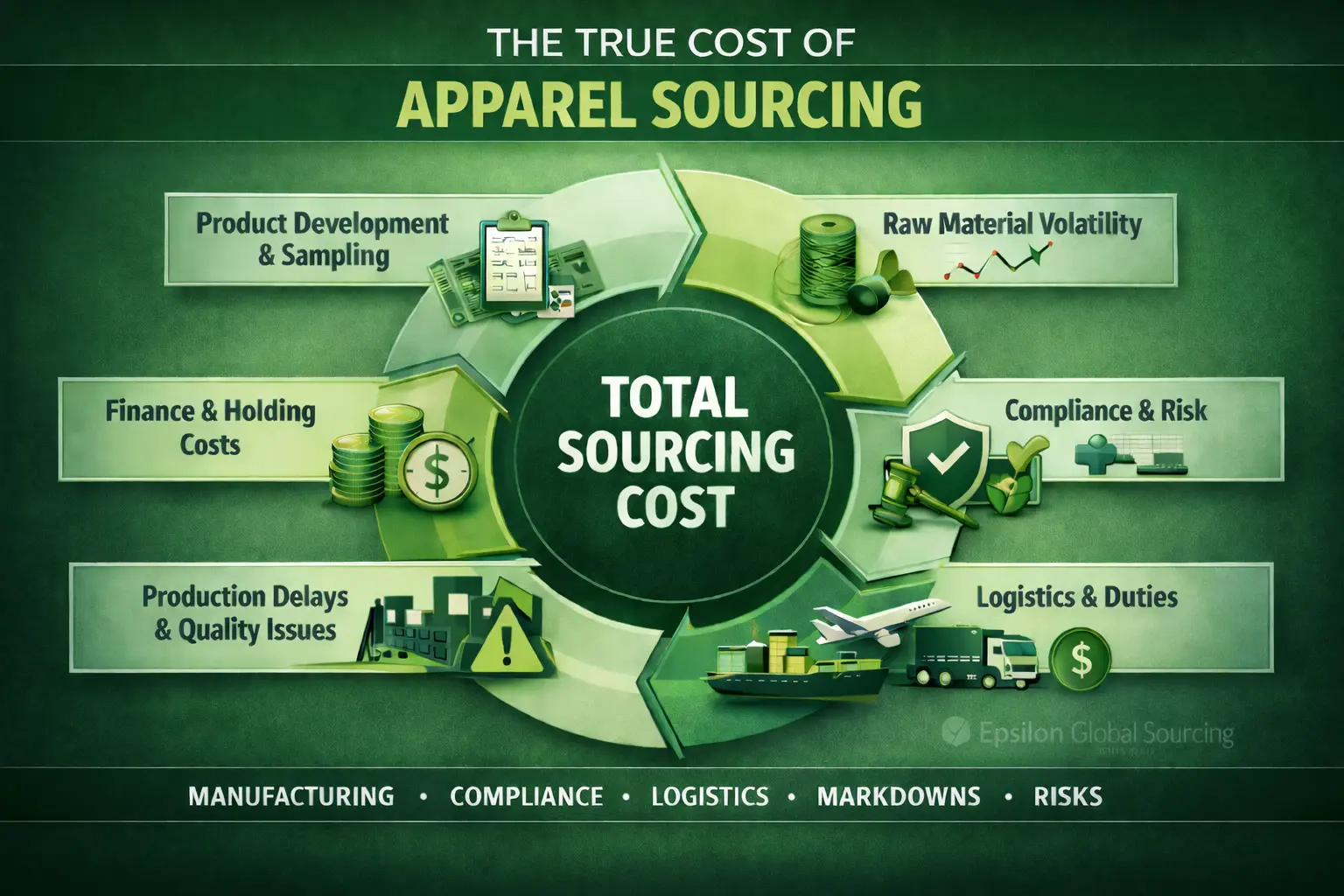
Executive Summary
Apparel sourcing is routinely misunderstood as a simple exercise in comparing factory prices. In reality, the true cost of apparel sourcing spans a complex system of commercial, operational, compliance, financial, and risk variables that materially affect margin, delivery reliability, and brand reputation.
This guide provides a ground-up, cost-layered analysis of apparel sourcing, garment manufacturing, and fashion sourcing operations. It explains where brands routinely underprice risk, how hidden costs accumulate across the sourcing lifecycle, and why professionally managed apparel sourcing consistently outperforms transactional buying.
This article is written for:
Fashion brands and retailers sourcing internationally
Buying offices and apparel sourcing agents
Procurement leaders responsible for margin protection
Founders building private-label or DTC fashion brands
It is intentionally evergreen and designed to anchor an apparel sourcing knowledge cluster covering supplier selection, sourcing strategy, compliance, and commercial execution.
Key Insights
FOB price represents only 55 to 70 percent of the true landed sourcing cost when risk, compliance, and execution variance are correctly modeled.
Supplier reliability and process maturity outperform low unit pricing as long-term margin drivers in apparel manufacturing sourcing.
Bangladesh apparel sourcing remains structurally cost-advantaged, but only when paired with professional compliance and QC governance.
Sourcing failure costs compound silently, often appearing as markdowns, chargebacks, missed seasons, or lost retail accounts.
Apparel sourcing agents reduce total cost, not unit cost, when properly structured and aligned with buyer outcomes.
Table of contents
ShowHide- Executive Summary
- Key Insights
- Understanding the Apparel Sourcing Cost Stack
- Cost Layer 1: Product Development and Pre-Production Costs
- Cost Layer 2: Raw Materials and Input Volatility
- Cost Layer 3: Manufacturing and Factory Economics
- Cost Layer 4: Quality Control and Defect Economics
- Cost Layer 5: Compliance and Regulatory Exposure
- Cost Layer 6: Logistics, Incoterms, and Trade Finance
- Cost Layer 7: Risk, Variance, and Opportunity Cost
- Cost Layer 8: Commercial Mechanics That Buyers Underestimate
- Cost Layer 9: Merchandising Decisions That Inflate Sourcing Cost
- Cost Layer 10: Country-Specific Cost Differentials in Apparel Manufacturing Sourcing
- Cost Layer 11: Opportunity Cost and Strategic Leakage
- Apparel Sourcing Process: Expanded Cost-Control Framework
- The Role of Apparel Sourcing Agents in Cost Compression
- Bangladesh Apparel Sourcing: Deep Cost Reality
- Bangladesh Apparel Sourcing: Cost Advantage With Conditions
- Apparel Sourcing Agent Economics Explained
- Final Buyer-Focused Takeaways
- Executive Buyer Checklist: Controlling the True Cost of Apparel Sourcing
Understanding the Apparel Sourcing Cost Stack
Why Apparel Sourcing Cost Is Systemic, Not Transactional
Most sourcing conversations begin and end with factory FOB pricing. This approach is structurally flawed.
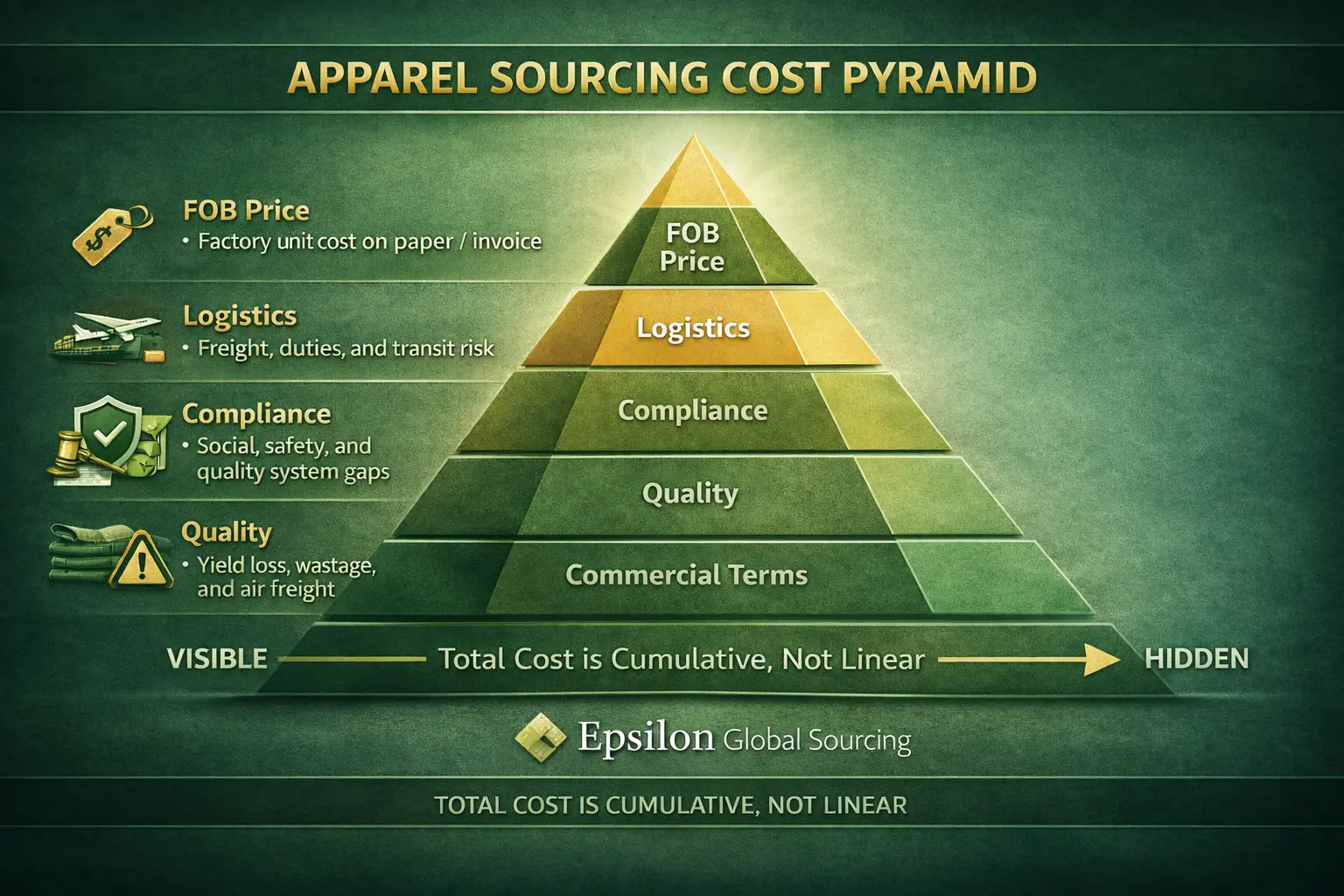
Apparel sourcing is a system, not a purchase order. Every sourcing decision triggers downstream cost consequences across quality, logistics, compliance, finance, and brand risk.
A professional apparel sourcing process evaluates total cost of ownership, not quoted price.
The Apparel Sourcing Cost Pyramid
Table: Apparel Sourcing Cost Pyramid Overview
| Cost Layer | Visibility | Typical Buyer Error |
|---|---|---|
| Quoted FOB Price | High | Over-optimised |
| Logistics & Duties | Medium | Underestimated |
| Quality Failures | Low | Ignored |
| Compliance Risk | Low | Deferred |
| Operational Friction | Very Low | Unmeasured |
| Strategic Risk | Invisible | Unpriced |
Cost Layer 1: Product Development and Pre-Production Costs
Tech Pack Accuracy and Interpretation Risk
The first hidden cost in apparel sourcing appears before production begins.
Incomplete or ambiguous tech packs lead to:
Fabric misinterpretation
Incorrect trims or construction
Excessive sample rounds
Delayed bulk approvals
Each additional sample iteration increases:
Development cost
Time to market
Opportunity cost
Sampling, Prototyping, and Pre-Production Samples
Sampling costs are often written off as unavoidable. In reality, they reflect sourcing maturity.
Common cost drivers
Multiple proto rounds due to poor briefings
Re-sampling caused by fabric unavailability
Last-minute construction changes
Professional apparel sourcing service providers reduce these costs through:
Pre-qualified supplier matching
Pattern engineering oversight
Fabric feasibility validation
Cost Layer 2: Raw Materials and Input Volatility
Fabric Cost Volatility
Fabric represents 50 to 65 percent of garment FOB cost in most categories.
Fabric pricing is affected by:
Cotton and synthetic commodity cycles
Yarn availability
Dyeing capacity constraints
Minimum order quantities
Trim, Accessories, and Packaging Leakage
Trims are frequently underestimated because they appear low-value individually.
In aggregate, they materially affect cost due to:
Low MOQ inefficiencies
Airfreight for missing components
Specification mismatches
Professional garment sourcing requires trim consolidation planning, not reactive purchasing.
Cost Layer 3: Manufacturing and Factory Economics
Labor Efficiency Versus Wage Rates
Low wages do not guarantee low manufacturing cost.
True manufacturing efficiency depends on:
Line balancing
Operator skill density
SMV accuracy
Production planning discipline
Capacity Risk and Production Congestion
Factories oversell capacity during peak seasons.
The cost impact includes:
Production delays
Quality shortcuts
Forced air shipments
Bangladesh apparel sourcing remains competitive because of scale density, but only when capacity planning is enforced.
Cost Layer 4: Quality Control and Defect Economics
Cost of Quality Failures
Quality issues rarely show up as a single cost line.
They manifest as:
Rework
Short shipments
Customer returns
Retail chargebacks
Table: Cost Impact of Quality Failure
| Failure Type | Direct Cost | Indirect Cost |
|---|---|---|
| Minor Defects | Rework | Delay |
| Major Defects | Rejections | Markdown |
| Compliance Failure | Shipment hold | Brand damage |
Inline vs Endline Inspection Strategy
Reactive endline QC is expensive.
Inline quality systems reduce:
Defect propagation
Rework volume
Inspection disputes
Professional apparel sourcing agents deploy process QC, not inspection-only models.
Cost Layer 5: Compliance and Regulatory Exposure
Audit and Certification Economics
Compliance costs are often perceived as overhead.
In reality, they are risk insurance.
Non-compliance triggers:
Shipment holds
Retailer blacklisting
Contract termination
Chemical, Safety, and ESG Risk
RSL, CPSIA, REACH, and ESG frameworks introduce non-negotiable cost layers.
Ignoring them results in:
Product recalls
Legal exposure
Reputation erosion
Fashion sourcing companies that internalise compliance governance consistently outperform price-only sourcing models.
Cost Layer 6: Logistics, Incoterms, and Trade Finance
Freight Volatility and Mode Selection
Freight costs fluctuate significantly by season and geopolitical risk.
Cost escalators include:
Congestion surcharges
Fuel adjustments
Forced mode switching
Payment Terms and Working Capital Cost
Letters of Credit, TT terms, and credit exposure directly affect cost of capital.
Improper payment structuring results in:
Supplier pricing buffers
Delayed production starts
Increased rejection risk
Cost Layer 7: Risk, Variance, and Opportunity Cost
Delay Cost and Missed Season Impact
The most expensive sourcing failure is missing the selling window.
Consequences include:
Markdown pressure
Inventory carryover
Brand credibility erosion
These costs rarely appear in sourcing spreadsheets, but they dominate P&L outcomes.
Supplier Failure and Re-Sourcing Cost
Switching suppliers mid-season triggers:
Re-development cost
Tooling loss
Compliance rework
Professional clothing sourcing agents price supplier stability, not just quotes.
Cost Layer 8: Commercial Mechanics That Buyers Underestimate
Incoterms and Hidden Cost Transfer
Incoterms are frequently treated as logistics formalities. In reality, they shift risk, cash flow timing, and cost exposure between buyer and supplier.
Most apparel sourcing transactions default to FOB, but buyers rarely model what that truly implies.
FOB transfers responsibility at vessel loading, not at factory gate. That means the buyer absorbs:
Port congestion risk
Vessel rollovers
Freight rate spikes
Documentation errors
Letters of Credit, TT, and Pricing Distortion
Payment terms materially affect factory pricing behavior.
Factories price differently based on:
Cash flow exposure
Financing cost
Default risk perception
Table: Payment Method Impact on FOB Pricing
| Payment Method | Factory Risk | Typical FOB Impact |
|---|---|---|
| 100% TT Advance | Low | Lower price |
| 30/70 TT | Medium | Neutral |
| Sight LC | Low | Neutral to low |
| Usance LC | Higher | Price buffer added |
Cost Layer 9: Merchandising Decisions That Inflate Sourcing Cost
Style Proliferation and MOQ Fragmentation
Excessive SKU counts are a silent cost amplifier.
Common merchandising-driven cost escalators include:
Low per-style quantities
Color fragmentation
Excessive size curves
Each increases:
Fabric wastage
Line inefficiency
Trim MOQs
Late Design Freezes and Change Orders
Late-stage changes are one of the most expensive sourcing behaviors.
They trigger:
Fabric write-offs
Re-cut costs
Air freight exposure
Professional apparel sourcing processes enforce design freeze governance, not informal approvals.
Cost Layer 10: Country-Specific Cost Differentials in Apparel Manufacturing Sourcing
Why Country Choice Is a Cost Strategy, Not a Geography Decision
Sourcing country selection affects:
Cost structure
Lead time reliability
Compliance exposure
Category fit
Table: Apparel Manufacturing Sourcing Country Snapshot
| Country | Cost Level | Strengths | Risk Profile |
|---|---|---|---|
| Bangladesh | Very Low | Scale, basics, denim | Compliance-sensitive |
| Vietnam | Medium | Technical apparel | Capacity tight |
| India | Medium | Vertical textiles | Lead time |
| China | High | Speed, complexity | Cost inflation |
Cost Layer 11: Opportunity Cost and Strategic Leakage
Time-to-Market as a Financial Variable
Time is a measurable cost, not a soft KPI.
Delays create:
Missed full-price selling windows
Margin erosion through markdowns
Inventory carryover
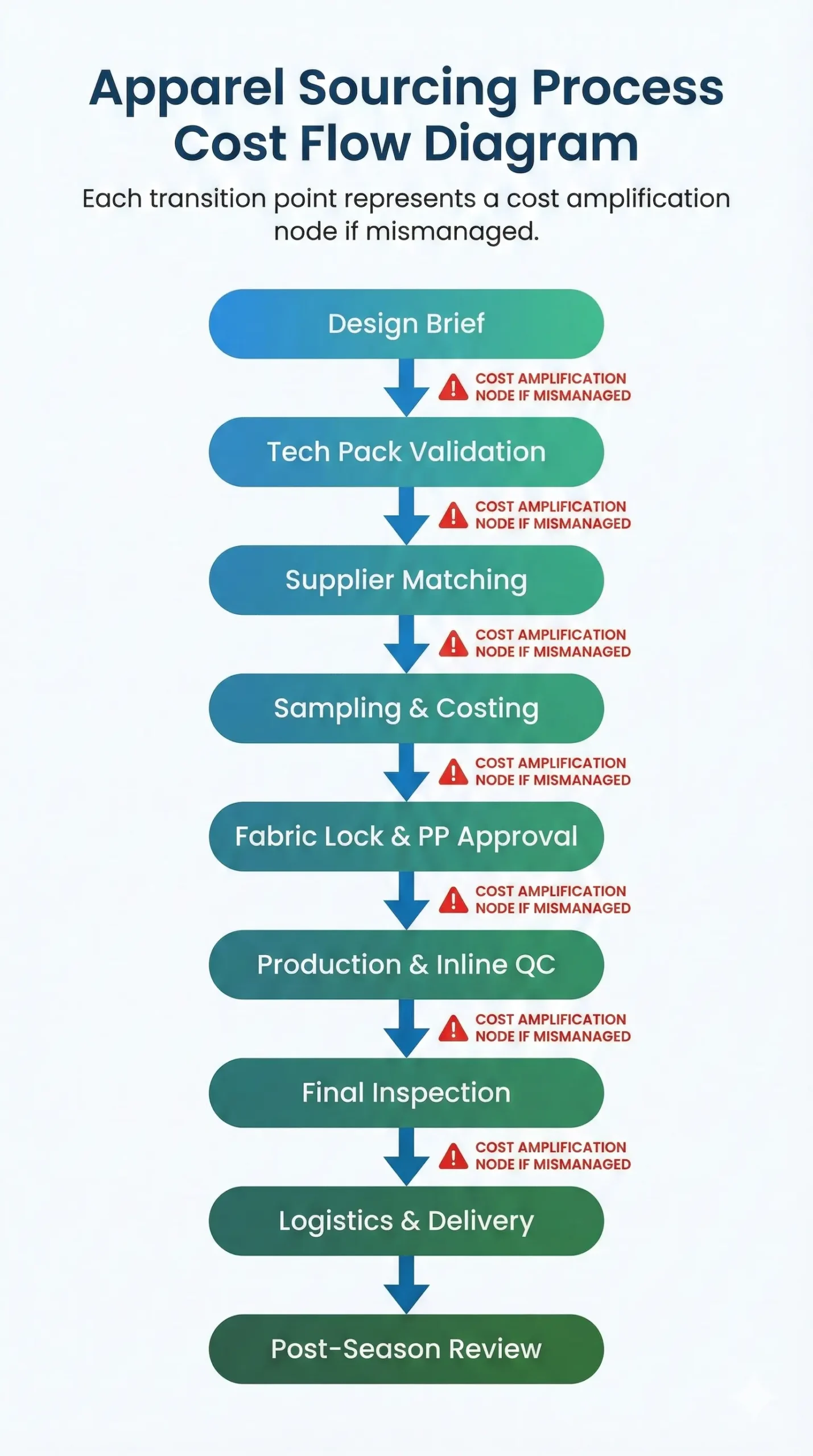
Apparel Sourcing Process: Expanded Cost-Control Framework
Stage 1: Strategic Supplier Mapping
Cost-efficient sourcing begins before RFQs.
Key activities:
Supplier capability scoring
Compliance pre-screening
Capacity seasonality mapping
This prevents:
Misaligned supplier selection
Costly mid-season switches
Stage 2: Commercial Structuring and Cost Modeling
Professional fashion sourcing companies build cost models, not quotes.
They model:
Fabric volatility scenarios
MOQ sensitivity
Currency exposure
Stage 3: Production Governance and Inline Controls
Execution discipline protects cost assumptions.
Key controls:
Inline QC checkpoints
Production milestone tracking
Exception escalation protocols
Stage 4: Post-Season Cost Attribution Review
Very few brands perform post-season sourcing reviews.
This step identifies:
Root causes of margin leakage
Supplier performance trends
Process improvement opportunities
The Role of Apparel Sourcing Agents in Cost Compression
What Apparel Sourcing Agents Actually Do
A professional apparel sourcing agent:
Reduces information asymmetry
Enforces process discipline
Aligns factory incentives
They do not replace buyers. They amplify buyer control.
Cost Myths About Sourcing Agents
Myth: Agents increase cost
Reality: They reduce variance and failure probability
Myth: Direct sourcing is cheaper
Reality: Only when execution capability already exists in-house.
Bangladesh Apparel Sourcing: Deep Cost Reality
Where Bangladesh Delivers Structural Advantage
Bangladesh excels in:
High-volume basics
Denim and woven categories
Long production runs
Cost advantages stem from:
Labor scale
Cluster density
Export specialization
Where Bangladesh Requires Professional Oversight
Risk areas include:
Compliance execution
Factory overbooking
Quality variance
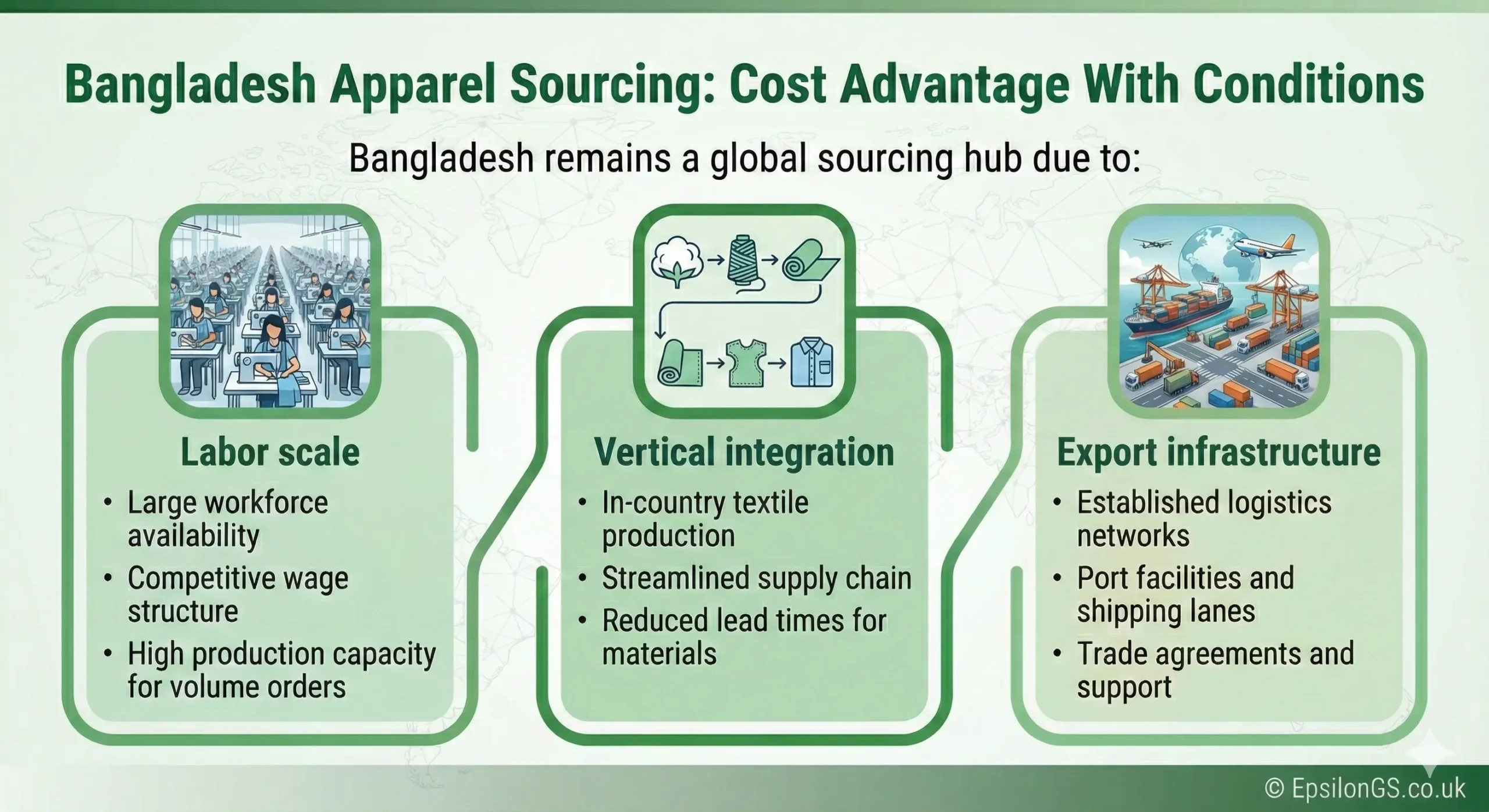
Bangladesh Apparel Sourcing: Cost Advantage With Conditions
Bangladesh remains a global sourcing hub due to:
Labor scale
Vertical integration
Export infrastructure
However, cost advantage only materialises when:
Compliance governance is active
QC systems are embedded
Capacity planning is enforced
Apparel Sourcing Agent Economics Explained
Why Apparel Sourcing Agents Reduce Total Cost
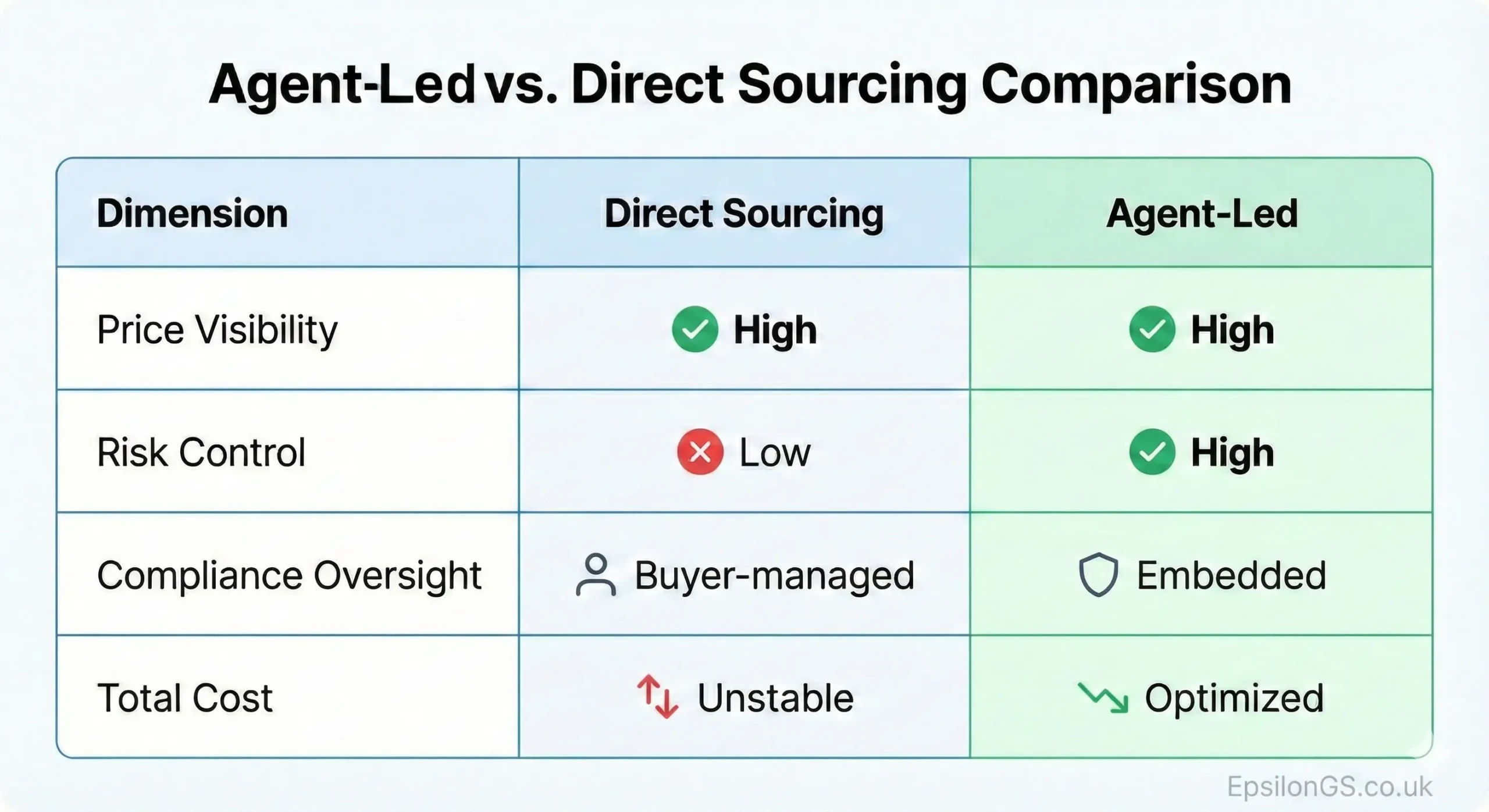
Contrary to misconception, sourcing agents do not add cost. They reallocate it.
They reduce:
Failure probability
Information asymmetry
Execution variance
Table: Agent-Led vs Direct Sourcing
| Dimension | Direct Sourcing | Agent-Led |
|---|---|---|
| Price Visibility | High | High |
| Risk Control | Low | High |
| Compliance Oversight | Buyer-managed | Embedded |
| Total Cost | Unstable | Optimised |
What Is the True Cost of Apparel Sourcing?
The true cost of apparel sourcing is the total financial, operational, and risk-adjusted cost incurred from product development to final delivery, not just the factory FOB price.
It includes:
Product development and sampling costs
Raw material volatility
Manufacturing efficiency and quality yield
Compliance and regulatory exposure
Logistics, duties, and trade finance
Delay risk, markdowns, and missed selling windows
FOB pricing typically represents only 55–70 percent of the true sourcing cost when all variables are accounted for.
Why FOB Price Alone Is a Misleading Metric in Fashion Sourcing
FOB price measures unit manufacturing cost, not sourcing success.
FOB pricing fails to capture:
Quality failure risk
Supplier reliability
Compliance exposure
Production delay probability
Working capital cost
Brands that optimise solely for FOB price consistently experience higher total cost and margin volatility.
How Apparel Sourcing Agents Reduce Total Cost
An apparel sourcing agent reduces total cost by controlling execution risk, not by negotiating lower unit prices.
They reduce cost through:
Supplier pre-qualification
Process governance
Inline quality control
Compliance enforcement
Capacity and timeline management
The economic value of an apparel sourcing agent lies in risk reduction, not price arbitrage.
Why Bangladesh Apparel Sourcing Remains Cost-Competitive
Bangladesh apparel sourcing remains globally competitive due to:
Labor scale and specialization
Dense manufacturing clusters
Strong export infrastructure
Competitive cost base for basics and denim
However, cost advantage only materialises when compliance, quality control, and production governance are actively managed.
What Are the Biggest Hidden Costs in Garment Sourcing?
The most common hidden costs in garment sourcing include:
Sampling inefficiencies
Fabric price volatility
Quality rework and rejections
Production delays
Air freight due to missed deadlines
Retail chargebacks and markdowns
These costs often exceed initial price savings achieved through aggressive FOB negotiation.
Final Buyer-Focused Takeaways
Apparel sourcing cost is cumulative, not linear
The cheapest supplier rarely delivers the lowest total cost
Professional sourcing processes outperform price negotiation
Bangladesh apparel sourcing remains dominant when risk is actively managed
Apparel sourcing agents reduce failure probability, which is the most expensive cost of all
Executive Buyer Checklist: Controlling the True Cost of Apparel Sourcing
Structured Buyer Checklist
☐ Evaluate total landed cost, not FOB
☐ Lock fabric early or price volatility will erase margin
☐ Enforce design freeze governance
☐ Model payment-term-driven pricing behavior
☐ Use inline QC, not inspection-only systems
☐ Treat compliance as revenue protection
☐ Perform post-season sourcing audits
If your brand is seeking a reliable apparel sourcing partner with access to Tier 1 and mid-tier factories in Bangladesh, Epsilon Global Sourcing provides:
End to end apparel sourcing service
Factory capability matching
Transparent costing breakdown
Compliance and audit oversight
Multi stage quality control
LC and documentation handling
Production tracking and reporting
Contact us to discuss your sourcing needs and strengthen your supply chain with a high performing Bangladesh apparel sourcing team.