
Apparel Sourcing Pitfalls: A Strategic Guide to Risk Management
January 21, 2026
What Is the Difference Between Apparel Sourcing and Garment Manufacturing?
February 18, 2026
Executive Summary
In global fashion sourcing, concentration risk kills brands.
A factory fails a social audit. A government imposes an export restriction. A port shuts down. A production line overbooks. Suddenly, your entire season is compromised because you trusted one supplier with everything.
A reliable apparel supplier portfolio is not a luxury. It is a structural necessity.
An Apparel Supplier Portfolio is a deliberately constructed network of diversified manufacturers, each allocated a strategic role based on product category, risk profile, capacity, geography, and innovation capability. It is managed with procurement discipline, compliance governance, and performance analytics.
Brands that rely on a single “do-it-all” factory are not efficient. They are exposed.
In this guide, you will learn:
How to adopt a portfolio mindset instead of transactional factory sourcing
How to apply the 70/20/10 allocation framework
How to conduct internal sourcing audits before engaging manufacturers
How to identify, vet, and trial factories across regions
How to implement Supplier Relationship Management systems that scale
If you operate in fashion sourcing, garment manufacturing, or apparel production at scale, this framework is non-negotiable.
Key Insights
No single factory can safely cover all product categories, risk scenarios, and capacity needs.
The 70/20/10 allocation model protects margin, agility, and innovation simultaneously.
Compliance certificates alone do not equal ethical manufacturing. Audit behavior, not paperwork.
Sampling phase communication speed is the strongest predictor of bulk reliability.
A structured Apparel Sourcing Risk Management framework reduces disruption exposure by 40–60% in multi-region sourcing models.
Table of contents
ShowHide- Executive Summary
- Key Insights
- The “Portfolio” Mindset: Why One Factory is Never Enough
- Step 1 - Internal Audit & Strategy Definition
- Step 2 - Identification & Sourcing Strategies
- Step 3 - The Rigorous Vetting Process
- Step 4 - The Sampling Phase & Trial Orders
- Supplier Relationship Management (SRM) & Scaling
- Conclusion
The “Portfolio” Mindset: Why One Factory is Never Enough
In global apparel manufacturing, concentration risk is one of the most underestimated threats to margin, reputation, and continuity.
Too many brands build their entire sourcing structure around a single “trusted” factory. It feels efficient. It feels simple. It feels loyal.
It is also structurally dangerous.
A reliable apparel supplier portfolio is not about spreading orders randomly. It is about strategic allocation of production across specialized partners to protect cost, speed, compliance, and innovation simultaneously.
If your sourcing strategy depends on one facility, you do not have a strategy. You have exposure.
1.1 The Myth of the “Do-It-All” Factory
When a factory claims it can manufacture:
Tailored wool suits
Performance outerwear
Technical sportswear
Structured blazers
Basic cotton t-shirts
Complex sustainable collections
You should pause.
Garment manufacturing is specialization-driven.
A factory engineered for high-volume knit production does not possess the same machinery, skill density, pressing infrastructure, or pattern engineering capability as a tailoring unit. Similarly, outerwear production requires technical seam sealing equipment and fabric handling expertise that a basic jersey factory simply does not operate.
When a supplier says yes to everything, one of three realities is usually true:
They are subcontracting without disclosure
They are trading rather than manufacturing
They are overstating capability to secure your order
Undisclosed subcontracting is not merely a commercial issue. It is a compliance risk. It undermines audit integrity, increases quality variability, and exposes your brand to reputational damage.
A disciplined portfolio mindset demands capability alignment. You select factories based on what they are structurally built to do, not what they promise in a meeting.
If a factory claims universal capability, assume hidden complexity
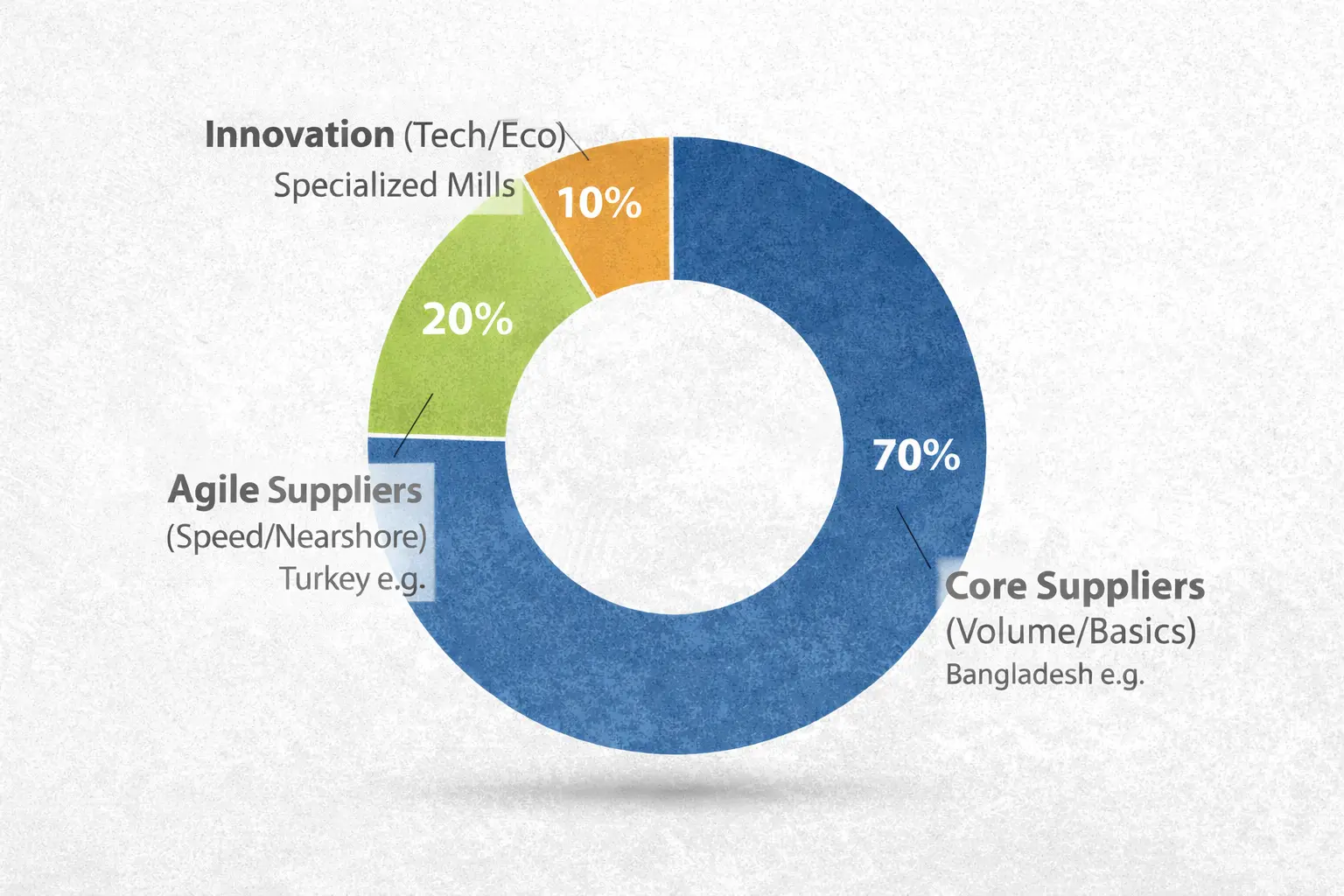
1.2 The 70/20/10 Allocation Rule
Professional procurement teams do not allocate 100 percent of volume to one supplier. They distribute strategically.
The 70/20/10 framework is a proven model in apparel sourcing.
70% Core Suppliers
High-volume, reliable, foundational production.
Typically established Clothing Manufacturers in Bangladesh for cotton basics, denim, fleece, and scalable programs. These suppliers deliver cost efficiency and production stability.
20% Secondary or Agile Suppliers
Nearshore factories for flexibility.
Countries such as Turkey or Portugal allow faster replenishment cycles and smaller MOQs. They protect speed and trend responsiveness.
10% Innovation Suppliers
Specialized manufacturers focused on:
Sustainable materials
Complex constructions
New technical processes
This includes partnerships with an eco-friendly clothing manufacturer using GOTS-certified fabrics or recycled synthetics.
This structure balances:
Margin protection
Agility
Innovation
A brand without diversification sacrifices at least one of these.
1.3 Risk Mitigation: Protecting the Supply Chain
Apparel Sourcing Risk Management is not theoretical. It is operational defense.
Risks include:
Geopolitical instability
Port congestion
Energy shortages
Natural disasters
Capacity overload during peak seasons
A single-factory strategy collapses under disruption.
A diversified portfolio absorbs shock.
For brands sourcing from Bangladesh, structured oversight through a UK Sourcing Office for Bangladesh Factories provides additional insulation. On-ground monitoring, compliance validation, and production visibility significantly reduce execution risk.
Without structured diversification, you are not managing supply. You are gambling on stability.
Buyer Takeaway:
One factory equals single-point failure.
Specialization matters more than promises.
The 70/20/10 model is foundational to modern apparel sourcing.
Risk diversification is a strategic obligation, not a luxury.
Portfolio thinking is the first step toward building a reliable apparel supplier ecosystem.
Step 1 - Internal Audit & Strategy Definition
Before you evaluate factories, evaluate your own structure.
Most sourcing failures do not originate in manufacturing. They originate in unclear internal strategy. If your product architecture, cost targets, compliance expectations, and lead time tolerances are undefined, you will attract the wrong suppliers and negotiate from a position of confusion.
Professional apparel sourcing begins with inward discipline.
2.1 Defining Your Product Matrix
A supplier portfolio cannot be built without clarity on what you actually produce.
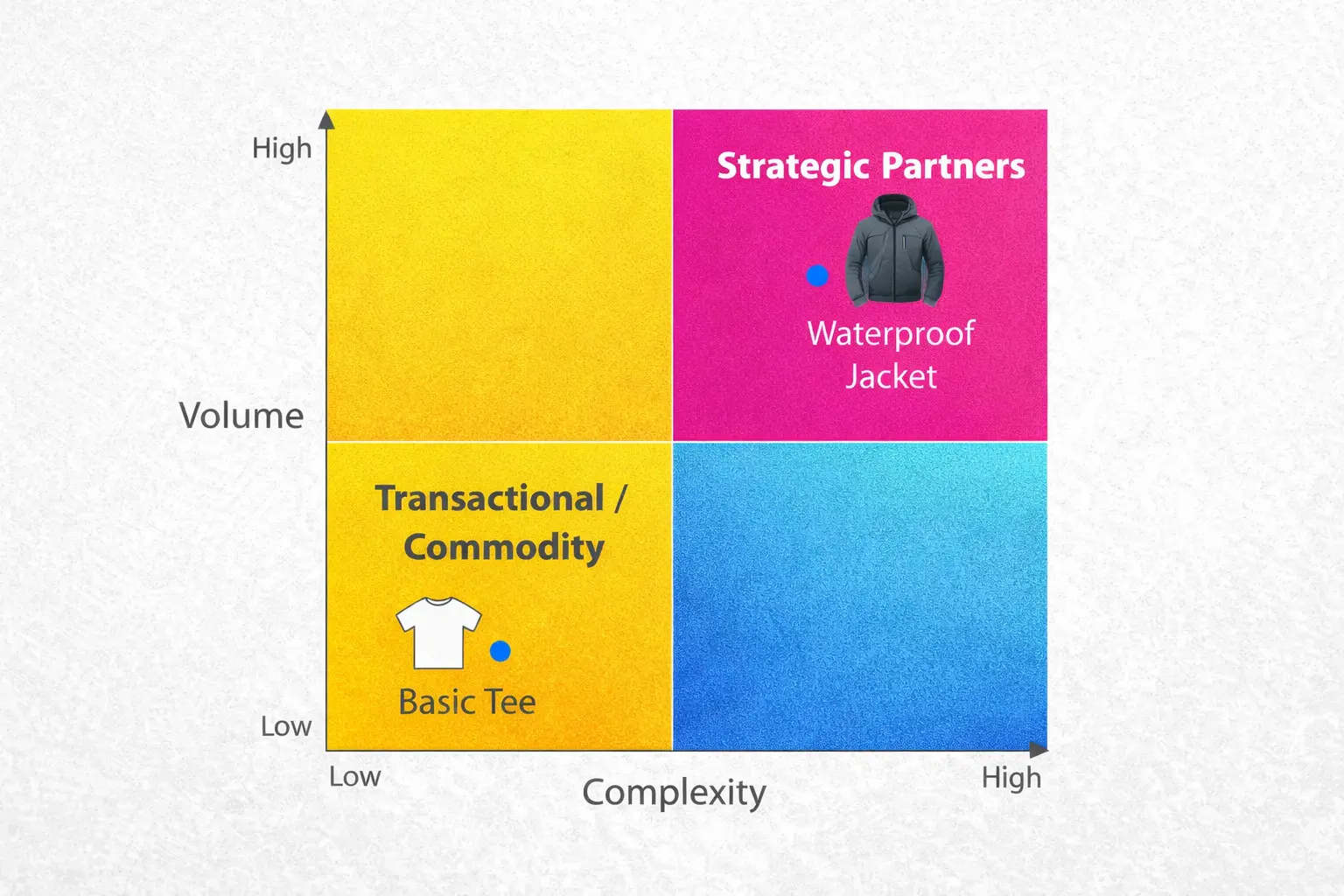
Start by mapping your Product Matrix across two primary axes:
1. Fabric Type
Knits
Wovens
Denim
Outerwear
Tailoring
2. Construction Complexity
Basic
Moderate
Technical
For example:
A basic jersey t-shirt and a structured blazer are not variations of the same production capability.
A fleece hoodie and a seam-sealed waterproof jacket require entirely different machinery ecosystems.
Create a structured table internally:
| Category | Fabric | Complexity | Expected Volume | Required Capability |
|---|---|---|---|---|
| Core Tee | Knit | Low | High | High-volume knit lines |
| Blazer | Woven | High | Medium | Tailoring specialist |
| Puffer Jacket | Synthetic | High | Low/Medium | Technical outerwear unit |
This matrix dictates your supplier segmentation.
Capability alignment prevents production friction.
If you skip this step, you will select factories based on price, not structural suitability.
2.2 Establishing the “Holy Trinity” of Sourcing
Before initiating supplier discussions, define the three non-negotiable commercial pillars:
• Target FOB Cost
Know your viable landed cost structure. Factories cannot manufacture within fantasy margins.
• Minimum Order Quantities (MOQs)
Understand your tolerance for volume commitment. Smaller MOQs often increase cost per unit and reduce supplier priority.
• Lead Times
Be explicit about production calendar expectations.
90 days ex-factory
60 days
45 days
These timelines influence geography selection, capacity planning, and pricing structures.
The absence of clarity here creates misalignment and negotiation breakdown.
Professional sourcing teams define the Holy Trinity before the first factory meeting.
2.3 Setting Compliance Non-Negotiables
Compliance cannot be reactive.
Before factory identification, determine:
Are Sedex audits mandatory?
Is amfori BSCI acceptable?
Is WRAP certification required?
Do you require GOTS or OEKO-TEX for sustainable collections?
If you operate in EU or UK markets, ESG scrutiny is intensifying. Selecting factories without defined compliance standards exposes your brand to reputational risk.
For brands sourcing from Bangladesh, alignment between factory certification and oversight through a UK Sourcing Office for Bangladesh Factories strengthens governance and audit transparency.
Do not negotiate compliance after price discussions. That signals weakness and creates friction.
Compliance standards are strategic filters, not optional add-ons.
Buyer Takeaway:
Define your product matrix before supplier outreach.
Establish FOB, MOQ, and lead time clarity internally.
Lock compliance criteria before negotiation.
Internal discipline is the foundation of external reliability.
Step 2 - Identification & Sourcing Strategies
Once internal strategy is defined, the next question is execution.
How do you actually find the right factories?
Identification is not a random search exercise. It is a structured filtering process aligned with your product matrix, commercial targets, and compliance framework.
3.1 Geographic Diversification: Mapping Global Manufacturing Strengths
Different countries dominate different segments of apparel manufacturing. A disciplined supplier portfolio reflects that reality.
Bangladesh
High-volume cotton programs
Denim
Fleece and jersey basics
Competitive FOB structures
Mature RMG export ecosystem
Bangladesh remains a global leader for scalable, cost-efficient production of foundational items. For brands building core collections, it is structurally difficult to ignore.
China
Technical synthetics
Performance fabrics
Integrated textile mills
Complex constructions
China’s vertical integration across fabric mills, trims, and garmenting offers advantages for innovation-heavy categories.
Vietnam
Outerwear
Sportswear
Structured manufacturing systems
Strong compliance alignment
Vietnam offers balanced cost structures with strong technical execution in performance segments.
Geographic diversification is not about chasing cheaper prices. It is about aligning regional strengths with product requirements.
Allocate production where capability is strongest, not where the sales pitch is loudest.
3.2 Direct-to-Factory vs Using an Apparel Sourcing Agent
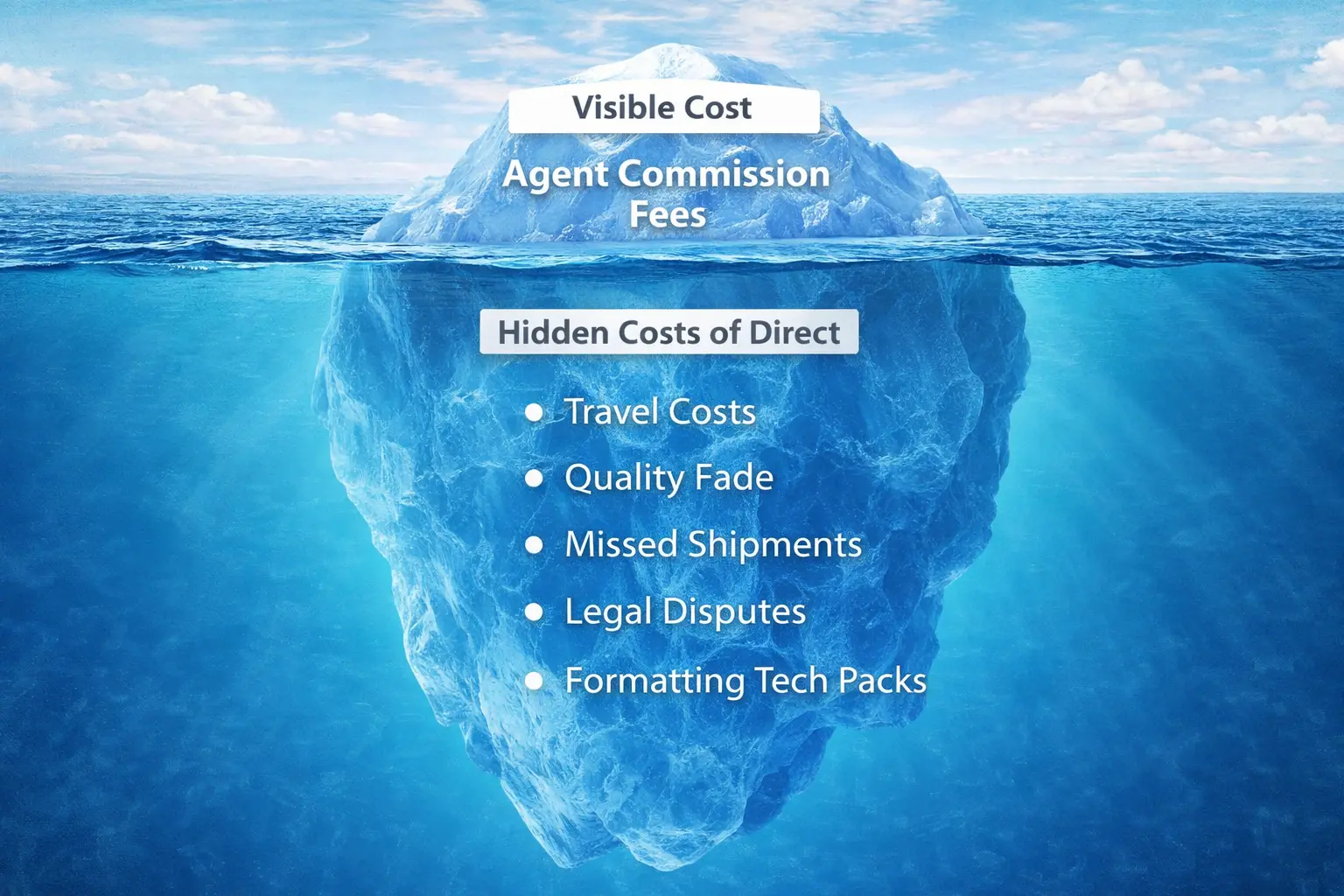
Many brands attempt to manage factories directly to avoid intermediary fees. On paper, this appears cost-efficient.
In practice, the hidden costs are substantial.
Direct factory management requires:
Daily production monitoring
Inline quality control
Audit verification
Subcontracting detection
Logistics coordination
Cultural and language fluency
Payment risk management
Without on-ground presence, you rely on email updates and factory assurances.
That is not control. That is distance.
A London-based Apparel Sourcing Agent operating a UK Sourcing Office for Bangladesh Factories provides structural advantages:
Physical factory visits
Real-time production visibility
Compliance verification
Immediate escalation handling
Transparent capacity validation
The financial cost of poor quality, shipment delays, or compliance failure routinely exceeds the commission paid to professional sourcing oversight.
The decision is not factory vs agent. It is unmanaged risk vs controlled execution.
If you do not have boots on the ground, you are operating on assumption.
3.3 Leveraging Trade Shows and Databases
Supplier discovery channels include:
Première Vision
Texworld
Regional garment expos
Curated B2B sourcing platforms
Trade shows are effective for:
Discovering innovation suppliers
Exploring fabric developments
Initial supplier introductions
However, exhibitions do not replace due diligence.
A polished booth does not equal production capability. A professional website does not equal financial stability.
Use trade shows to expand your funnel. Use structured vetting to narrow it.
Buyer Takeaway
Align country selection with product specialization.
Direct management without on-ground oversight increases risk exposure.
Professional sourcing infrastructure reduces execution friction.
Trade shows open doors. Rigorous vetting protects margins.
Identification is not about finding the cheapest factory. It is about building a diversified, capability-aligned supplier ecosystem that can scale with confidence.
Step 3 - The Rigorous Vetting Process
Identification creates a shortlist. Vetting determines survival.
This is the stage where professional sourcing separates itself from amateur procurement. A polished presentation, competitive FOB, and fast sampling are not indicators of long-term reliability.
A factory becomes a portfolio partner only after it survives structured scrutiny.
4.1 Financial Stability and Capacity Audits
A factory collapse mid-production is one of the most expensive disruptions a brand can face.
Before onboarding any supplier, assess:
Financial Indicators
Years in operation
Export markets served
Banking relationships
Consistency of order volume
Ownership structure
You are not requesting confidential balance sheets, but you are evaluating stability signals. Factories dependent on one or two buyers carry concentration risk. If one buyer exits, your production becomes vulnerable.
Capacity Verification
Do not accept capacity claims at face value. Audit:
Number of active production lines
Average operators per line
Daily output per line
Machine condition and age
Line balancing efficiency
For example:
If a factory claims a 500,000-piece monthly capacity but operates 8 sewing lines with average daily outputs of 800 pieces per line, the math must align.
Capacity inflation is common. Overbooking is more common.
Production math must validate production claims.
If your order represents more than 30–40 percent of a factory’s total output, you must assess dependency risk on both sides.
4.2 Compliance & Ethical Standards: Beyond Certificates
Certificates such as Sedex, BSCI, or WRAP are baseline indicators. They are not proof of daily practice.
During vetting, investigate:
Is subcontracting disclosed and approved?
Are overtime hours within legal frameworks?
Are workers aware of grievance mechanisms?
Are fire exits genuinely accessible and unobstructed?
Are safety drills documented and practiced?
Undisclosed subcontracting is the most dangerous compliance breach. It bypasses audits and transfers your production to unknown facilities.
Ask direct questions:
What percentage of orders are internally produced?
Under what conditions is subcontracting used?
How are subcontractors audited?
If answers are evasive, that is data.
Real compliance is visible in behavior, not paperwork.
4.3 Quality Control Infrastructure
Quality must be engineered systematically.
Key questions include:
Does the factory operate an internal QC team?
Are inline inspections standard procedure?
Is there a documented quality manual?
What AQL level do they naturally operate at?
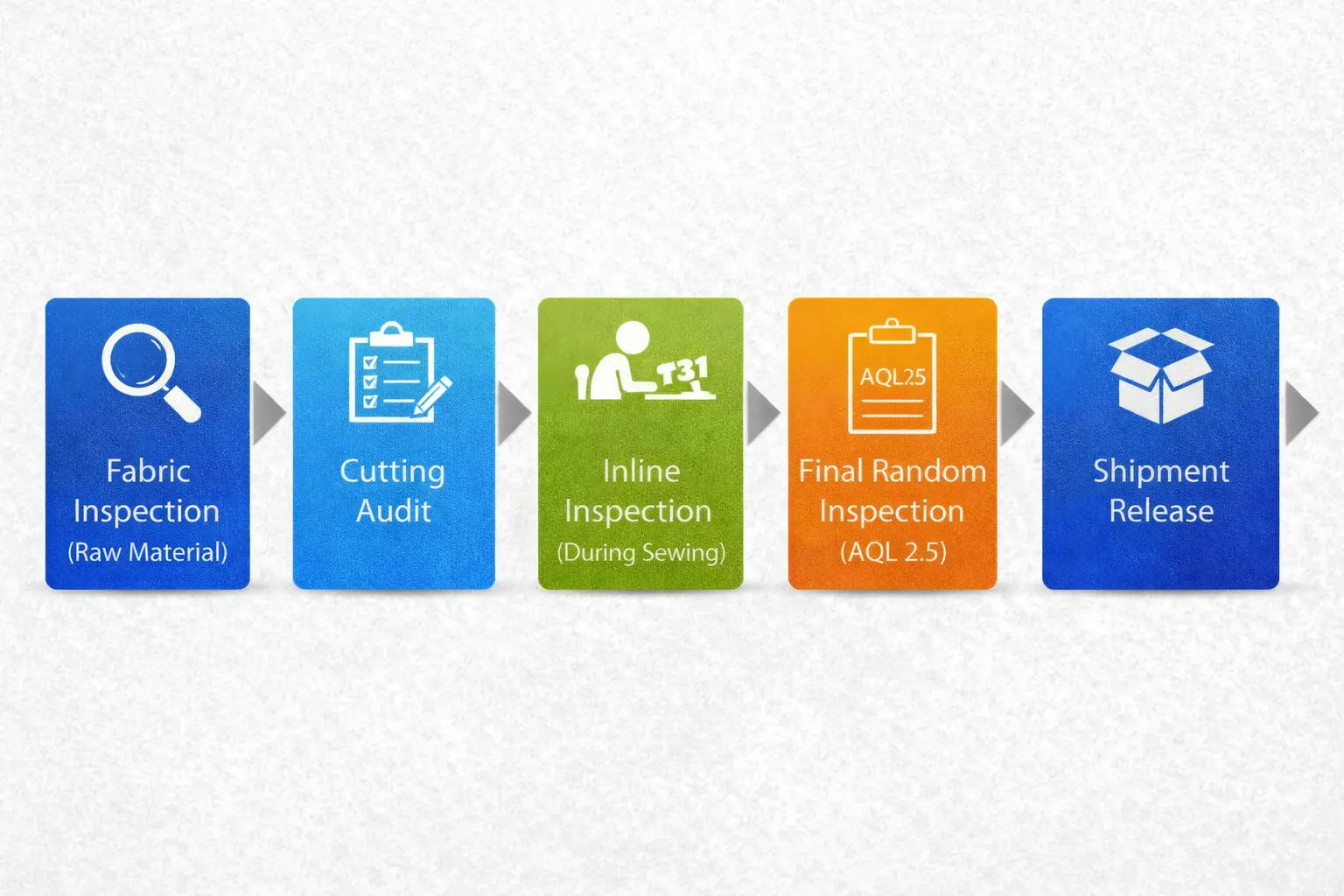
Professional factories typically align with:
AQL 2.5 for major defects
Structured inline inspections
Final random inspection before shipment
Observe the process flow:
Fabric inspection on arrival
Cutting panel audits
Inline sewing inspections
Midline quality review
Final random inspection
If QC is only performed at the final stage, defect containment is reactive rather than preventative.
Additionally, evaluate:
Defect tracking systems
Root cause analysis practices
Rework management procedures
A factory that tracks defect percentages per line demonstrates maturity. A factory that blames operators without data demonstrates weakness.
Quality is not a department. It is a system.
Buyer Takeaway
Verify financial and operational stability before commitment.
Treat compliance behavior as more important than certificates.
Demand structured QC infrastructure, not final-stage inspection only.
Rigorous vetting transforms sourcing from opportunistic buying into controlled supply chain governance.
Step 4 - The Sampling Phase & Trial Orders
Identification selects candidates. Vetting filters them.
Sampling reveals the truth.
The sampling phase is not a formality. It is a stress test of systems, communication discipline, and technical competence. This is where many brands make a critical mistake: they treat sampling as a technical step rather than a behavioral indicator.
You are not only testing the garment. You are testing the organization.
5.1 The “Hidden” KPI – Communication
During sampling, responsiveness becomes your most accurate predictive metric.
Measure:
How quickly they acknowledge a tech pack
How precisely they interpret measurements
How thoroughly they flag construction risks
How proactively they suggest improvements
How transparently they communicate delays
Factories that reply slowly during sampling will not accelerate during bulk production.
Factories that ignore minor fit comments will not suddenly become meticulous at scale.
Sampling communication reveals:
Internal coordination strength
Merchandising discipline
Technical understanding
Management responsiveness
If your emails require repeated follow-ups during sampling, expect operational friction during bulk.
Sampling responsiveness is a leading indicator of production reliability.
5.2 The Approval Funnel
Professional apparel manufacturing follows a structured approval sequence. Skipping stages introduces uncontrolled risk.
The standard progression:
Proto Sample
First physical interpretation of the tech pack
Focus on construction feasibility
Fit Sample
Adjustments to measurements and silhouette
Ensures commercial wearability
Size Set
Confirms grading accuracy across sizes
Prevents scaling errors in bulk
Pre-Production (PP) Sample
Final confirmation in bulk-approved fabric and trims
Mirrors actual production conditions
Each stage filters risk.
The PP sample is particularly critical. It validates:
Fabric behavior after cutting
Trims compatibility
Wash outcomes
Labeling accuracy
Skipping directly from fit approval to bulk production is reckless.
5.3 The First Bulk Order Strategy
Never allocate 100 percent of projected capacity to a new factory on the first run.
Even after successful sampling, unknown variables remain:
Line balancing performance
Operator skill variance
Real-time QC discipline
Shipment coordination accuracy
Best practice:
Allocate 20–30 percent of expected volume
Select lower-complexity SKUs
Maintain tight inspection oversight
Treat the first bulk order as a controlled pilot, not a full rollout.
Monitor:
On-time delivery performance
Defect rates
Communication under pressure
Corrective action speed
If performance aligns with expectations, scale incrementally.
If not, you have limited exposure.
Trust should scale with proven execution, not optimism.
Buyer Takeaway
Evaluate communication rigorously during sampling.
Follow the full approval funnel without shortcuts.
Pilot bulk orders before strategic allocation.
Sampling is not about fabric and fit alone. It is about validating whether a supplier deserves a place in your portfolio.
Supplier Relationship Management (SRM) & Scaling
Building a supplier portfolio is one discipline. Maintaining and scaling it is another.
Many brands invest heavily in identification and vetting, then default to transactional buying behavior once production stabilizes. That approach caps growth and weakens leverage.
Supplier Relationship Management, or SRM, is where portfolio strategy becomes long-term competitive advantage.
6.1 From Transactional to Strategic Partnerships
Transactional sourcing looks like this:
Last-minute orders
Aggressive price-only negotiations
No forward visibility
Frequent supplier switching
Strategic sourcing looks different.
Professional buyers:
Share seasonal forecasts early
Provide projected volume visibility
Involve factories in fabric planning
Collaborate on cost engineering
When factories receive early forecasts, they can:
Secure fabric in advance
Plan line allocation
Optimize labor planning
Offer more competitive pricing
Priority is rarely given to the loudest buyer. It is given to the most predictable buyer.
Factories prioritize partners who reduce uncertainty.
When suppliers view your brand as long-term volume rather than opportunistic business, negotiation shifts from adversarial to collaborative.
6.2 Implementing Supplier Scorecards
SRM without measurement is subjective.
Implement quarterly scorecards tracking:
On-Time Delivery (OTD) Percentage
Quality Pass Rate at Final Inspection
Defect Rate Trends
Communication Responsiveness
Cost Stability vs Agreed FOB
A simple rating structure (for example, 1 to 5 scale) creates objective comparison across suppliers.
This allows you to:
Allocate future volume rationally
Identify performance decline early
Reward high performers with increased share
Data-driven allocation reinforces discipline across your portfolio.
What gets measured gets managed.
6.3 Handling Disputes: The Safety Net
Even strong suppliers can fail inspections.
When a shipment fails, the process must be controlled:
Immediate defect categorization
Root cause analysis
Rework feasibility evaluation
Commercial settlement discussion
Possible outcomes include:
Rework at factory expense
Partial discount agreements
Air freight cost absorption
Order cancellation
Without structured mediation, disputes escalate quickly.
This is where a professional Apparel Sourcing Company provides protection. Acting as intermediary, it:
Conducts independent inspection
Documents defect evidence
Negotiates remediation
Preserves long-term supplier relationships
For brands sourcing in Bangladesh or other high-volume hubs, structured oversight and escalation management prevent isolated quality failures from becoming systemic damage.
Disputes are inevitable. Un-managed disputes are avoidable.
Buyer Takeaway
Long-term partnerships unlock pricing and production priority.
Scorecards transform relationships from emotional to data-driven.
Professional sourcing oversight protects margin during disputes.
SRM is not administrative maintenance. It is strategic control of your apparel supplier portfolio.
Conclusion
Building a reliable Apparel Supplier Portfolio is deliberate work.
It requires:
Strategic allocation
Structured vetting
Controlled trial orders
Ongoing performance management
This is not procurement administration. It is risk engineering.
Managing a diversified portfolio across regions, compliance frameworks, and product categories is a full-time discipline.
If your brand requires a Reliable Apparel Sourcing Partner with a UK Sourcing Office for Bangladesh Factories to oversee production and reduce risk exposure, engage a team that understands Apparel Sourcing Risk Management at operator level.
The cost of poor sourcing exceeds the cost of professional oversight.
Choose structure over improvisation.
Frequently Asked Questions About Building an Apparel Supplier Portfolio
If your brand is seeking a reliable apparel sourcing partner with access to Tier 1 and mid-tier factories in Bangladesh, Epsilon Global Sourcing provides:
End to end apparel sourcing service
Factory capability matching
Transparent costing breakdown
Compliance and audit oversight
Multi stage quality control
LC and documentation handling
Production tracking and reporting
Contact us to discuss your sourcing needs and strengthen your supply chain with a high performing Bangladesh apparel sourcing team.