
The Strategic Guide to Building a Resilient Apparel Supplier Portfolio
February 16, 2026
Why Bangladesh Is One of the Strongest Apparel Sourcing Destinations in 2026
February 19, 2026
Introduction
Most fashion brands and garment sourcing companies use the terms apparel sourcing and garment manufacturing interchangeably.
That confusion is expensive.
At surface level, both functions sit within the same supply chain. Both are required to produce garments. Both interact daily. However, structurally, they are not the same discipline. They operate at different strategic altitudes, require different competencies, and carry different risk exposures.
Failing to distinguish between them leads to misaligned contracts, weak cost control, compliance exposure, and chronic production delays.
The core distinction is straightforward:
Sourcing is strategy.
Manufacturing is execution.
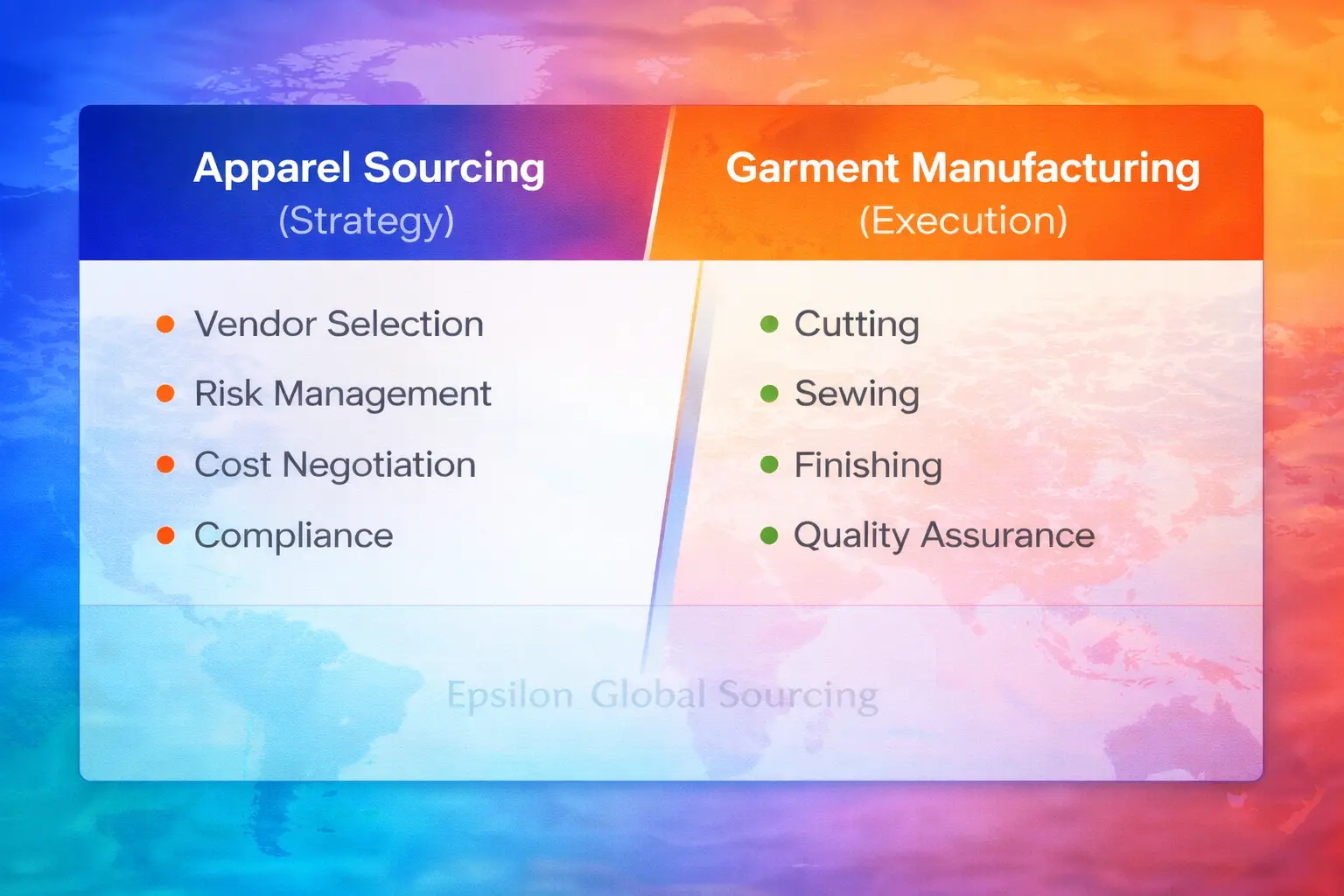
Apparel sourcing governs vendor selection, country allocation, cost architecture, compliance standards, logistics strategy, and risk management. It answers the questions of where, with whom, and under what commercial and regulatory structure production will occur.
Garment manufacturing, by contrast, is industrial transformation. It converts fabric into finished product through cutting, sewing, finishing, quality control, and packing. It optimizes efficiency, manages line output, and controls operational defects.
One builds the supply chain architecture.
The other runs the factory floor.
This distinction matters because performance in one does not compensate for failure in the other.
A brand can partner with a technically excellent factory and still lose margin due to poor regional sourcing decisions, currency miscalculations, or weak compliance governance. Conversely, a perfectly structured sourcing strategy collapses if factory execution lacks discipline.
The thesis is simple but non-negotiable:
You can have great manufacturing and still fail due to poor sourcing.
You need both, aligned and disciplined, to survive in modern apparel.
The remainder of this article has clarified where the boundary sits, where the handover occurs, and how these two engines must operate in coordinated alignment.
Table of contents
ShowHide- Introduction
- Key Takeaways
- The Core Definitions
- Strategic Distinction at a Glance
- The Workflow - Where Do They Meet?
- Strategic Insight
- The 5 Key Strategic Differences
- Strategic Summary
- Deep Dive – The Financial Models (Crucial for B2B)
- Executive Insight
- Strategic Sourcing vs. Tactical Production
- Executive Synthesis
- Sustainability – The Great Divider
- Executive Conclusion
- When to Use a Sourcing Agent vs. Direct-to-Factory
- Executive Synthesis
- Conclusion
Key Takeaways
1. Sourcing Is Strategic Governance; Manufacturing Is Tactical Execution
Sourcing determines:
Country allocation
Vendor selection
Cost structure
Compliance framework
Risk exposure
Manufacturing determines:
Line efficiency
Quality consistency
Output reliability
Operational stability
Confusing the two creates accountability gaps.
2. Costing Models Reveal Structural Differences
Sourcing evaluates total landed exposure including:
Freight
Duty
Tariffs
Raw material procurement
Manufacturing focuses on:
CMT
SMV
Labor efficiency
Machine utilization
Factory price alone never reflects total commercial risk.
3. Risk Profiles Operate at Different Levels
Sourcing risks are systemic:
Geopolitical instability
Currency volatility
Compliance failure
Manufacturing risks are operational:
Machine breakdown
Labor disruption
Fabric defects
Effective brands manage both layers simultaneously.
4. Sustainability Requires Dual Alignment
Sustainable fabric selection without green manufacturing is incomplete.
Green factories without verified raw material sourcing lack traceability.
Material governance and factory discipline must operate together.
5. Operating Model Choice Determines Exposure
Direct-to-factory models increase internal management burden.
Agent-led models reduce structural risk but introduce commission cost.
The correct choice depends on internal capability depth, not perceived savings.
In modern apparel, competitive advantage is not built solely on price or design.
It is built on the disciplined integration of sourcing strategy and manufacturing execution.
The Core Definitions
At board level, confusion between apparel sourcing and garment manufacturing leads to structural errors in cost control, supplier selection, and risk allocation. These are not interchangeable functions. They operate at different layers of the apparel value chain and require distinct competencies, governance models, and accountability structures.
Understanding the distinction is foundational for brands evaluating a Garment Sourcing Company, building an internal sourcing team, or engaging factories directly.
1.1 What Is Apparel Sourcing?
Apparel sourcing is the end-to-end procurement lifecycle of apparel production.
It governs how a brand identifies, evaluates, negotiates with, and manages suppliers before and during production. It is commercial, strategic, and risk-oriented in nature.
Scope of Apparel Sourcing
Apparel sourcing typically includes:
Market research and country analysis
Vendor identification and vetting
Commercial negotiation and costing analysis
Raw material procurement strategy including fabric mills and trim suppliers
Capacity planning and production allocation
Compliance verification and audit coordination
Risk management and contingency planning
Logistics coordination and shipment oversight
In essence, sourcing decides who produces, where it is produced, at what cost, and under what risk profile.
Apparel sourcing is not about stitching garments. It is about structuring the commercial ecosystem around production.
A sophisticated Garment Sourcing Company does not operate sewing lines. Instead, it orchestrates a network of manufacturers, textile mills, compliance frameworks, and logistics partners to optimize cost, quality, and reliability.
Key Players in Apparel Sourcing
Sourcing Agents
Procurement Managers
Buyers
Country Managers
Compliance Coordinators
These stakeholders operate from brand offices, regional hubs, or independent sourcing firms. Their accountability is commercial performance and risk mitigation, not machine efficiency.
1.2 What Is Garment Manufacturing?
Garment manufacturing is the industrial transformation of raw materials into finished apparel products.
It is operational, technical, and production-focused.
While sourcing governs supplier selection and commercial structuring, manufacturing executes the physical production process.
Scope of Garment Manufacturing
Garment manufacturing includes:
Pattern making
Grading
Marker planning
Fabric spreading
Cutting operations
Sewing line assembly
Washing and finishing
Pressing and packing
Quality Assurance (QA) and inline inspections
This is factory-floor execution. It requires machinery, trained labor, technical supervisors, and production planning systems.
Manufacturing answers the question: “How do we convert fabric into compliant, wearable finished goods at scale?”
Key Players in Garment Manufacturing
Factory Owners
Production Managers
Line Supervisors
Industrial Engineers
Quality Control (QC) Inspectors
Their metrics are:
Line efficiency
Output per hour
Defect rates
Rework percentages
On-time production completion
Unlike sourcing professionals, manufacturing managers are accountable for operational throughput, not strategic supplier selection.
Strategic Distinction at a Glance
| Dimension | Apparel Sourcing | Garment Manufacturing |
|---|---|---|
| Core Function | Procurement lifecycle | Industrial production |
| Focus | Commercial strategy and risk | Operational execution |
| Primary Risk | Supplier failure, compliance breach | Production inefficiency, quality defects |
| Accountability | Cost, reliability, governance | Output, efficiency, defect control |
| Typical Operator | Garment Sourcing Company, brand sourcing office | Factory or manufacturing unit |
In summary:
Apparel sourcing is strategic orchestration.
Garment manufacturing is operational execution.
Brands that conflate these roles expose themselves to structural inefficiencies. Mature fashion companies treat sourcing as a governance function and manufacturing as a controlled execution engine.
Contact us to discuss apparel sourcing requirements in Bangladesh.
Our team provides factory matching, costing transparency, compliance oversight, and end to end production management.
The Workflow - Where Do They Meet?
If Section 1 defined the disciplines, Section 2 defines the operational handshake.
The interface between apparel sourcing and garment manufacturing is not abstract. It is procedural. It occurs at a precise moment in the production lifecycle and determines whether execution will be controlled or chaotic.
Misalignment at this junction is one of the primary structural causes of margin erosion and delivery failure.
2.1 The Pre-Production Handover
The transition from sourcing to manufacturing is formal, contractual, and technical.
The End of the Sourcing Phase
The sourcing phase concludes when:
Purchase Order (PO) is issued and confirmed
Final price is agreed
Tech Pack is approved and frozen
Fabric and trims are nominated or secured
Lead time is contractually aligned
Compliance documentation is validated
At this point, commercial risk has been structured. Supplier capability has been evaluated. Cost architecture has been agreed.
Once the PO is signed and the Tech Pack is frozen, ambiguity must end. Manufacturing execution begins.
For a professional Garment Sourcing Company, this handover is controlled. Documentation is complete. Risk flags are communicated. Dependencies are mapped.
Weak sourcing governance, by contrast, leads to incomplete tech packs, unresolved costing disputes, and fabric uncertainty entering production.
That is not a manufacturing failure. It is a sourcing failure transferred downstream.
The Beginning of the Manufacturing Phase: The Pre-Production Meeting (PPM)
Manufacturing formally begins with the Pre-Production Meeting (PPM).
The PPM is not a ceremonial meeting. It is a technical alignment checkpoint.
It typically covers:
Review of final Tech Pack
Construction validation
Measurement tolerances
Fabric shrinkage data
Trim approvals
Packaging instructions
Quality standards and AQL parameters
Production timeline confirmation
Key participants include:
Production Manager
Line Supervisor
Quality Assurance Manager
Industrial Engineer
Sometimes a sourcing representative or brand QA
The PPM converts commercial agreement into executable factory instructions.
If the sourcing team exits prematurely or fails to provide structured documentation, the factory fills the gaps with assumptions. Assumptions in garment manufacturing translate directly into defects.
2.2 The Parallel Tracks
After handover, sourcing and manufacturing do not operate sequentially. They operate in parallel.
Understanding this dual-track dynamic is critical.
Track One: Sourcing Team – Critical Path Governance
While the factory runs production, sourcing teams manage the Time and Action (T&A) calendar, also known as the critical path.
Their responsibilities include:
Monitoring raw material arrival timelines
Tracking lab dip approvals
Managing sample approvals
Ensuring shipping bookings are secured
Coordinating inspection schedules
Escalating delays early
Sourcing teams operate at a macro level. They oversee:
Supplier performance
Cross-style allocation
Country-level risk
Commercial exposure
They do not manage sewing lines. They manage production risk.
A mature sourcing organization understands that proactive governance is the only sustainable Garment Production Delays Solution. Delays are rarely sudden. They are visible in milestone slippage long before the ex-factory date is missed.
Track Two: Manufacturing Team – Floor Execution
Simultaneously, the factory manages operational execution:
Line balancing
Worker allocation
Capacity utilization
Daily output monitoring
Inline quality control
Rework management
Manufacturing leadership focuses on:
Pieces per hour
Efficiency percentage
Defect rates
Bottleneck identification
Overtime control
Their battlefield is the production floor.
If sourcing miscalculates lead time or overloads the factory, floor efficiency collapses. If manufacturing mismanages workflow, even a perfect sourcing strategy cannot protect delivery timelines.
The Intersection: Information Flow
The intersection between sourcing and manufacturing is information velocity.
Weekly production reports
WIP status updates
Inline inspection findings
Fabric arrival confirmations
When communication slows, risk compounds.
Apparel supply chains fail quietly before they fail publicly.
Strong governance requires:
Real-time milestone tracking
Early-warning escalation systems
Structured cross-functional reporting
This is where experienced sourcing partners differentiate themselves. They do not wait for problems to mature. They detect variance at the micro-milestone level.
Strategic Insight
The sourcing function hands over commercial authority.
The manufacturing function assumes operational responsibility.
From that moment forward:
Sourcing governs time and risk.
Manufacturing governs output and quality.
They meet at the PPM.
They operate in parallel until shipment release.
Brands that blur these responsibilities create accountability gaps. Brands that define them clearly build scalable, resilient supply chains.
Contact us to discuss apparel sourcing requirements in Bangladesh.
Our team provides factory matching, costing transparency, compliance oversight, and end to end production management.
The 5 Key Strategic Differences
If Sections 1 and 2 explained what apparel sourcing and garment manufacturing are, and where they intersect, this section clarifies how they diverge structurally.
These are not minor distinctions. They define governance architecture, cost control mechanisms, and risk allocation across the supply chain.
3.1 Scope & Responsibility
The most fundamental difference lies in altitude of perspective.
Sourcing = Macro Governance
Apparel sourcing operates at a global, portfolio level. It evaluates:
Country risk exposure
Political and regulatory stability
Currency volatility
Freight routes and logistics resilience
Supplier concentration risk
Trade agreements and tariff structures
Sourcing determines whether production should sit in Bangladesh, Turkey, Vietnam, or nearshore Europe. It allocates volume across factories and countries.
It answers:
Where should we produce, under what commercial structure, and with what risk tolerance?
A sourcing team may oversee dozens of factories across multiple geographies.
Manufacturing = Micro Execution
Garment manufacturing operates at factory-floor granularity. It focuses on:
Line efficiency percentage
Needle downtime
Operator productivity
Machine maintenance
Inline defect rates
Rework control
Manufacturing answers:
How do we achieve daily output targets with controlled defect rates?
A production manager does not evaluate geopolitical exposure. They evaluate output per operator.
3.2 Financial Structure (Costing)
Cost architecture differs materially between the two functions.
Sourcing Focus: Landed Duty Paid (LDP)
Sourcing evaluates total commercial exposure. That includes:
Cost of Goods Sold (COGS)
Freight
Insurance
Import duties
Tariffs
Inland transportation
This aggregated figure is the Landed Duty Paid (LDP) cost.
For example, in categories such as Sustainable Denim Production, sourcing must also factor:
Water treatment compliance costs
Environmental certifications
Sustainable fiber premiums
Wastewater processing investments
These macro cost drivers sit outside pure stitching economics.
Sourcing optimizes the total landed cost, not just the FOB price.
Manufacturing Focus: CMT and SMV
Manufacturing costing is operational.
Key metrics include:
CMT (Cut, Make, Trim) cost
SMV (Standard Minute Value)
Labor cost per minute
Line efficiency percentage
Manufacturers analyze:
SMV × Cost per minute ÷ Efficiency
This determines sewing cost per garment.
Manufacturing does not calculate tariffs. It calculates production minutes.
3.3 Risk Profiles
Risk exposure differs in nature and magnitude.
Sourcing Risks
Geopolitical instability
Currency fluctuation
Trade sanctions
Port congestion
Compliance failures
Reputational damage
If sourcing misjudges country risk, the entire season can collapse.
Manufacturing Risks
Machine breakdown
Worker absenteeism
Labor unrest
Fabric shade variation
Pattern inconsistencies
Quality control lapses
These are operational risks. They are immediate and technical.
Sourcing risks are systemic. Manufacturing risks are operational.
Both matter. They simply operate at different levels.
3.4 Relationship Dynamics
The relationship model also differs.
Sourcing = Partnership & Leverage
Sourcing teams negotiate:
Pricing
Payment terms
MOQs
Volume commitments
Capacity reservation
They balance leverage with long-term partnership. A mature sourcing strategy ensures supplier sustainability while protecting brand margins.
Manufacturing = Capacity & Consistency
Manufacturing relationships revolve around:
Capacity planning
Line allocation
Technical feasibility
Engineering discipline
Output predictability
Factories value stable forecasts and consistent order flow. Their leverage is capacity control.
Negotiation matters less than engineering stability.
3.5 Compliance & Ethics
Finally, governance differs in authorship and execution.
Sourcing Sets the Standard
Sourcing teams define:
Code of Conduct
Social compliance requirements
Environmental expectations
Audit frequency
Certification thresholds
For instance, in Sustainable Denim Production, sourcing may mandate:
ZDHC compliance
Wastewater treatment standards
Reduced water washing technologies
Restricted chemical lists
These are policy decisions.
Manufacturing Implements the Standard
Factories operationalize those requirements:
Fire safety systems
Worker wage compliance
Working hour regulation
Effluent treatment plant (ETP) operation
Chemical management
On-site documentation
If sourcing designs weak standards, compliance risk escalates.
If manufacturing fails implementation, reputational damage follows.
Strategic Summary
Across five dimensions, the distinction is clear:
Scope: Global governance vs floor execution
Costing: LDP vs CMT/SMV
Risk: Systemic vs operational
Relationships: Negotiation vs engineering discipline
Compliance: Policy design vs operational implementation
Apparel sourcing defines the commercial architecture.
Garment manufacturing executes the industrial reality.
Contact us to discuss apparel sourcing requirements in Bangladesh.
Our team provides factory matching, costing transparency, compliance oversight, and end to end production management.
Deep Dive – The Financial Models (Crucial for B2B)
For B2B buyers, the distinction between apparel sourcing and garment manufacturing becomes most visible in the financial model.
This is where many commercial misunderstandings originate.
Factory quotations, sourcing margins, freight exposure, duty impact, and working capital structure all sit within this framework. If executives do not understand these models, margin leakage is inevitable.
4.1 FOB (Free on Board) vs. CMT (Cut-Make-Trim)
The commercial lens differs depending on whether you are operating from a sourcing perspective or a manufacturing perspective.
FOB (Free on Board) – The Sourcing-Oriented Model
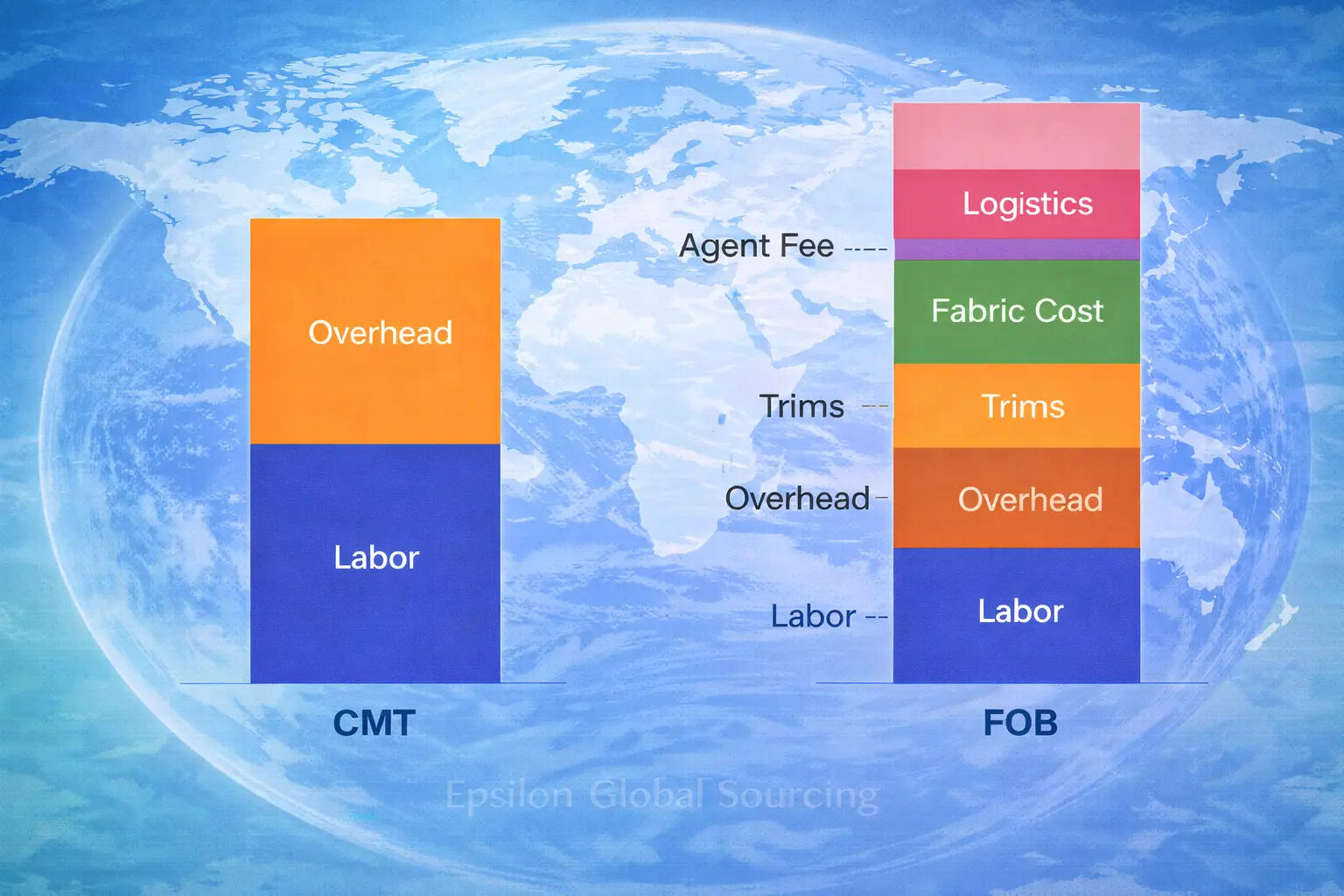
FOB pricing represents a full-service manufacturing model.
Under FOB, the factory typically manages:
Fabric sourcing
Trim procurement
Production
Packaging
Inland transport to port
Export documentation
The buyer pays for the goods once they are loaded onto the vessel at the origin port.
Sourcing teams predominantly operate within the FOB framework because it simplifies governance and accountability.
FOB transfers procurement complexity to the factory while allowing sourcing teams to evaluate total supplier capability.
When working with a full-service supplier, sourcing professionals assess:
Fabric mill relationships
Raw material buying power
Compliance standards
Working capital capacity
Integrated quality systems
In categories such as denim or outerwear, FOB enables better integration across fabric mills, laundries, and finishing units. This is especially relevant in technical segments like Sustainable Denim Production, where fabric development, washing processes, and environmental compliance are interlinked. FOB ensures responsibility is centralized.
From a sourcing standpoint, FOB supports:
Consolidated risk management
Reduced coordination burden
Clear accountability for delays
CMT (Cut, Make, Trim) – The Manufacturing-Oriented Model
Under a CMT model, the buyer supplies:
Fabric
Major trims
Sometimes packaging
The factory provides:
Labor
Machinery
Factory overhead
Sewing and finishing execution
Manufacturing quotes only for operational transformation.
CMT pricing is driven by:
SMV (Standard Minute Value)
Labor cost per minute
Efficiency rate
Overhead allocation
CMT shifts raw material risk to the buyer.
CMT is an execution contract. FOB is a supply chain contract.
Factories may prefer CMT when:
They lack fabric sourcing strength
Buyers demand nominated mills
Raw material volatility is high
The buyer wants direct mill control
However, CMT increases coordination complexity. The sourcing team must now manage fabric booking, freight, customs, and arrival timelines independently.
For inexperienced sourcing teams, this model introduces avoidable risk.
4.2 The Hidden Costs of Poor Sourcing
The most expensive sourcing mistakes are rarely visible in the factory quotation.
They appear in aggregate.
Regional Misalignment
Choosing the wrong country or region can negate the most competitive factory price.
Consider a scenario:
Factory A offers a lower CMT cost.
Region A has higher freight rates.
Region A faces currency instability.
Region A has longer transit times.
Region A is exposed to port congestion risk.
On paper, the manufacturing cost looks attractive. In practice, total landed cost increases.
A strong factory cannot compensate for a structurally flawed sourcing decision.
Structural Cost Erosion
Common hidden cost drivers include:
Tariff differentials
Duty exposure
Longer cash conversion cycles
High minimum order quantities
Rework due to capability mismatch
Compliance remediation costs
For example:
If sourcing selects a region with weak environmental infrastructure, factories may require additional wastewater treatment investments to meet brand standards. Those costs eventually surface in pricing or delays.
Similarly, misaligned lead times can force:
Air freight upgrades
Overtime production
Split shipments
Air freight alone can erase the margin of an entire season.
The Manufacturing Reality
Factories optimize for what they control:
Labor efficiency
Machine utilization
Output per line
They cannot control:
Trade policy
Port delays
Currency depreciation
Political disruption
When sourcing miscalculates macro variables, the factory absorbs pressure until the pressure becomes non-operational.
At that point, delivery slips or quality degrades.
Executive Insight
FOB and CMT are not simply pricing formats. They represent different governance models.
FOB aligns with strategic sourcing and integrated accountability.
CMT aligns with operational execution and buyer-controlled material flow.
Poor sourcing decisions amplify manufacturing risk.
Strong sourcing architecture enhances manufacturing performance.
In B2B apparel, margin protection begins long before the first stitch is sewn.
Contact us to discuss apparel sourcing requirements in Bangladesh.
Our team provides factory matching, costing transparency, compliance oversight, and end to end production management.
Strategic Sourcing vs. Tactical Production
At executive level, the distinction between sourcing and manufacturing becomes a matter of strategy versus execution bandwidth.
One governs a diversified supply portfolio.
The other optimizes a single production engine.
Understanding this distinction is critical for brands scaling across geographies, price tiers, and product categories.
5.1 The “Portfolio” Approach
Strategic Sourcing Thinks in Portfolios
Apparel sourcing operates under a portfolio logic.
It does not rely on a single factory. It balances:
Core strategic partners
Secondary capacity buffers
Developmental or niche suppliers
This structure mirrors financial portfolio management.
Many advanced sourcing organizations apply allocation frameworks such as the 70/20/10 rule:
70% allocated to stable, high-performance core suppliers
20% to flexible or emerging suppliers
10% to innovation or risk-diversification partners
This approach protects against:
Capacity shocks
Political disruptions
Category concentration risk
Cost inflation exposure
Strategic sourcing distributes risk before risk materializes.
A sourcing director evaluates factories across countries, capabilities, and compliance maturity. Decisions are based on total supply resilience, not emotional loyalty to a single vendor.
This is governance at scale.
Tactical Manufacturing Thinks in Lines
Manufacturing, by contrast, focuses on optimizing the throughput of one facility at a time.
A factory’s objectives are:
Fill sewing lines
Maintain efficiency
Reduce idle machine time
Balance workflow
A production manager is not balancing a multi-country portfolio. They are balancing:
Line A versus Line B
Operator allocation
Overtime hours
Bottleneck resolution
Manufacturing maximizes utilization. Sourcing optimizes allocation.
The factory wants predictable volume.
The sourcing function wants diversified stability.
These objectives are complementary, but structurally different.
5.2 Raw Material Control
The most pivotal operational difference between sourcing and manufacturing lies in one question:
Who controls the fabric?
In apparel, fabric represents:
50 to 70 percent of garment cost
The primary determinant of quality
The largest lead time variable
A significant compliance exposure
Control over raw materials determines power within the supply chain.
Pure Manufacturing Model: Buyer-Supplied Fabric
In a pure manufacturing or CMT structure:
The brand purchases fabric directly from nominated mills
Fabric is shipped to the factory
The factory only performs cutting and sewing
This gives the buyer:
Full mill transparency
Direct price negotiation with textile suppliers
Strong control over fiber content and sustainability claims
However, it also increases coordination complexity.
The brand must manage:
Fabric production timelines
Freight to factory
Customs clearance
Shade consistency
Bulk quality risk
If fabric arrives late, the factory’s lines go idle. Idle capacity increases tension and inefficiency.
Full-Package Sourcing Model: Fabric Procurement Integrated
In a full-package sourcing model:
The sourcing partner or factory procures fabric
Mills are selected based on cost, performance, and compliance
Fabric and production are synchronized
This reduces coordination burden and centralizes accountability.
When fabric and manufacturing are aligned under one structure, timeline control improves significantly.
A sophisticated sourcing partner evaluates:
Mill capacity
Environmental compliance
Dyeing infrastructure
Lead time consistency
Price volatility exposure
They negotiate fabric at scale across multiple styles and seasons.
This is where strategic sourcing creates leverage.
Structural Implication
Fabric control determines:
Working capital structure
Lead time risk
Sustainability credibility
Cost volatility exposure
Manufacturing executes what it receives.
Sourcing determines what is procured and under what terms.
Executive Synthesis
Section 5 reinforces a fundamental principle:
Sourcing is strategic portfolio governance.
Manufacturing is tactical capacity optimization.
Sourcing distributes volume across multiple factories, manages macro risk, and governs raw material strategy.
Manufacturing concentrates on execution excellence within a single production environment.
Brands that treat sourcing as transactional procurement and manufacturing as interchangeable capacity misunderstand the structural architecture of the apparel supply chain.
True competitive advantage lies in separating strategic sourcing discipline from tactical production execution, while ensuring both operate in disciplined alignment.
If you would like, I can now draft the concluding section that synthesizes all five sections into a board-level strategic framework.
Contact us to discuss apparel sourcing requirements in Bangladesh.
Our team provides factory matching, costing transparency, compliance oversight, and end to end production management.
Sustainability – The Great Divider
Sustainability has become the most visible fault line between sourcing governance and manufacturing execution.
Brands frequently market sustainability at a material level while overlooking production-level environmental realities. This structural disconnect creates reputational exposure, regulatory risk, and commercial vulnerability.
Sustainability in apparel is not a single lever. It operates across two distinct but interdependent layers:
Sustainable sourcing
Green manufacturing
Treating one without the other is strategically incomplete.
6.1 Sustainable Sourcing
Material and Certification Governance
Sustainable sourcing begins at the raw material level.
It involves selecting:
Organic cotton
Recycled polyester
Regenerative fibers
Low-impact dyes
Certified sustainable viscose
Traceable wool or cashmere
It also includes enforcing certification frameworks such as:
GOTS (Global Organic Textile Standard)
Fair Trade
OEKO-TEX
GRS (Global Recycled Standard)
Sourcing teams are responsible for:
Verifying supplier certifications
Ensuring chain-of-custody documentation
Validating fiber authenticity
Conducting due diligence on mills
Aligning material selection with ESG commitments
Sustainable sourcing is a procurement discipline grounded in traceability and verification.
It answers:
Where does the fiber originate?
Is the mill certified?
Is the supply chain auditable?
Are environmental claims defensible?
A strategic sourcing function evaluates sustainability at the ecosystem level, not merely the SKU level.
The Strategic Risk
If sourcing selects uncertified mills or fails to validate documentation, sustainability claims become marketing fiction.
Regulatory frameworks in the EU, UK, and US are increasingly scrutinizing greenwashing. The sourcing function now carries compliance accountability, not just commercial accountability.
6.2 Green Manufacturing
If sustainable sourcing governs inputs, green manufacturing governs execution.
This is where environmental impact becomes tangible.
Green manufacturing includes:
Effluent Treatment Plants (ETP)
Advanced wastewater recycling systems
Low-liquor ratio dyeing machines
Solar panel installations
Energy-efficient boilers
Heat recovery systems
Zero-waste cutting optimization
Chemical management protocols
Worker health and safety systems
Manufacturing responsibility includes:
Proper chemical storage
Wastewater treatment compliance
Emission control
Responsible waste disposal
Fire safety compliance
Ethical wage adherence
Working hour monitoring
Manufacturing sustainability is operational discipline, not policy documentation.
A factory may produce garments using organic cotton.
If its wastewater is discharged untreated, sustainability collapses.
The Critical Misalignment
This is where brands often fail.
They may:
Source certified sustainable fabric
Promote recycled fibers in marketing
Highlight eco-friendly labels
Yet they may place production in facilities with:
Poor wastewater management
Excessive overtime violations
Weak chemical control
Unsafe working conditions
This creates a structural contradiction.
You can source “Sustainable Fabric” and still manufacture in a “Dirty Factory.”
Sustainability requires both:
Ethical and traceable raw material procurement
Environmentally compliant industrial execution
Without alignment, ESG strategy becomes fragmented.
The Governance Implication
Sourcing must:
Select compliant mills
Enforce Code of Conduct standards
Audit environmental certifications
Manufacturing must:
Implement wastewater treatment
Maintain worker welfare systems
Invest in energy efficiency
Reduce material waste
One designs the standard.
The other operationalizes it.
Neither alone is sufficient.
Executive Conclusion
Sustainability is not an attribute. It is an integrated governance framework.
Sustainable sourcing controls fiber integrity and certification compliance.
Green manufacturing controls environmental execution and worker welfare.
True sustainability requires alignment across both layers.
Brands seeking resilience, regulatory compliance, and long-term credibility must integrate sourcing discipline with manufacturing accountability.
Anything less is reputational risk disguised as strategy.
Contact us to discuss apparel sourcing requirements in Bangladesh.
Our team provides factory matching, costing transparency, compliance oversight, and end to end production management.
When to Use a Sourcing Agent vs. Direct-to-Factory
This is not a tactical question. It is a structural operating model decision.
Choosing between working directly with a factory and engaging a sourcing agent determines:
Internal headcount requirements
Risk exposure
Speed of execution
Compliance governance
Commercial leverage
The wrong model does not merely reduce efficiency. It alters the risk architecture of the brand.
7.1 The “Direct” Route
Under the direct model, the brand contracts factories without intermediary oversight.
The brand assumes full responsibility for:
Supplier identification
Capability assessment
Price negotiation
Fabric procurement alignment
Critical path monitoring
Quality control scheduling
Compliance auditing
Logistics coordination
This model appears attractive on paper.
Pros of Direct-to-Factory
Lower apparent cost due to no agent commission
Direct commercial negotiation
Greater visibility into production
Stronger long-term supplier relationships
Full control over communication
In mature organizations with internal sourcing teams, this model can be efficient.
However, cost savings are often overstated.
Cons of Direct-to-Factory
Increased internal headcount requirement
Higher travel and audit costs
Greater exposure to country-level risk
Limited regional diversification
Dependency on single-factory capability
Slower issue resolution if local oversight is weak
Removing the agent does not remove complexity. It transfers complexity internally.
Brands without experienced sourcing infrastructure often underestimate:
Fabric risk coordination
Compliance enforcement
Capacity verification
Cultural and regulatory nuances
Direct models require:
In-country presence
Technical production expertise
Strong compliance systems
Structured milestone tracking
Without these, the brand becomes operationally exposed.

7.2 The “Agent” Route
Under the agent model, the brand partners with a sourcing intermediary who manages supplier networks and production oversight.
The agent acts as:
Commercial negotiator
Factory selector
Risk assessor
Quality gatekeeper
Compliance coordinator
Logistics facilitator
This model allows the brand to concentrate on:
Design
Merchandising
Brand positioning
Retail strategy
Market expansion
Strategic Advantages of Using an Agent
A capable sourcing agent provides:
Pre-vetted factory networks
Multi-country allocation flexibility
Real-time factory floor visibility
Structured critical path management
Early risk detection
Consolidated reporting
Instead of managing five factories independently, the brand interfaces with one strategic partner.
An agent compresses supply chain complexity into a single point of accountability.
Agents also balance portfolios. If one factory faces capacity constraints, volume can shift within the network.
This diversification is difficult under a single-factory direct model.
Financial Perspective
While agents charge a commission, the hidden value often includes:
Reduced defect rates
Lower delay probability
Improved negotiation leverage
Compliance risk mitigation
Consolidated shipping coordination
In many cases, the commission is offset by:
Avoided air freight upgrades
Reduced rework
Better raw material negotiation
Lower failure rates
When Direct Makes Sense
Large brands with internal sourcing offices
Dedicated compliance teams
Strong in-country presence
High annual volume with specific factories
When Agent Model Makes Sense
Growing brands without sourcing infrastructure
Multi-country sourcing strategies
Complex categories requiring technical coordination
Brands prioritizing design and speed-to-market
Executive Synthesis
Direct-to-factory is an internalized model of control.
Agent-based sourcing is a delegated model of governance.
Direct offers potential margin efficiency but increases management burden.
Agent models introduce commission but reduce structural risk.
The correct choice depends on organizational maturity, internal expertise, and risk tolerance.
Brands must evaluate not just cost, but capability depth and execution discipline before deciding.
Conclusion
The distinction between apparel sourcing and garment manufacturing is not semantic. It is structural.
Sourcing defines the architecture of the supply chain.
Manufacturing powers the physical execution of that architecture.
Sourcing is strategy.
It governs:
Vendor selection
Country allocation
Cost frameworks
Raw material control
Compliance standards
Risk exposure
It determines whether the commercial model is resilient or fragile before production even begins.
Manufacturing is the engine.
It executes:
Cutting
Sewing
Finishing
Quality assurance
Packing
Throughput optimization
It determines whether production runs efficiently, consistently, and on time.
One without the other is insufficient.
A technically strong factory cannot compensate for flawed sourcing decisions rooted in weak country selection, poor compliance governance, or miscalculated landed costs.
Equally, a sophisticated sourcing strategy collapses if the production floor lacks discipline, engineering rigor, and quality control.
Strategy without execution is theoretical.
Execution without strategy is unstable.
Sustainable profitability in apparel requires both engines to operate in disciplined alignment.
Brands that understand this distinction design resilient supply chains.
Brands that blur it absorb avoidable cost, delay, and reputational risk.
In modern apparel, competitive advantage is not built by choosing between sourcing and manufacturing.
It is built by mastering the strategic orchestration of both.
Frequently Asked Questions: Apparel Sourcing vs. Garment Manufacturing
If your brand is seeking a reliable apparel sourcing partner with access to Tier 1 and mid-tier factories in Bangladesh, Epsilon Global Sourcing provides:
End to end apparel sourcing service
Factory capability matching
Transparent costing breakdown
Compliance and audit oversight
Multi stage quality control
LC and documentation handling
Production tracking and reporting
Contact us to discuss your sourcing needs and strengthen your supply chain with a high performing Bangladesh apparel sourcing team.