
What Is the Difference Between Apparel Sourcing and Garment Manufacturing?
February 18, 2026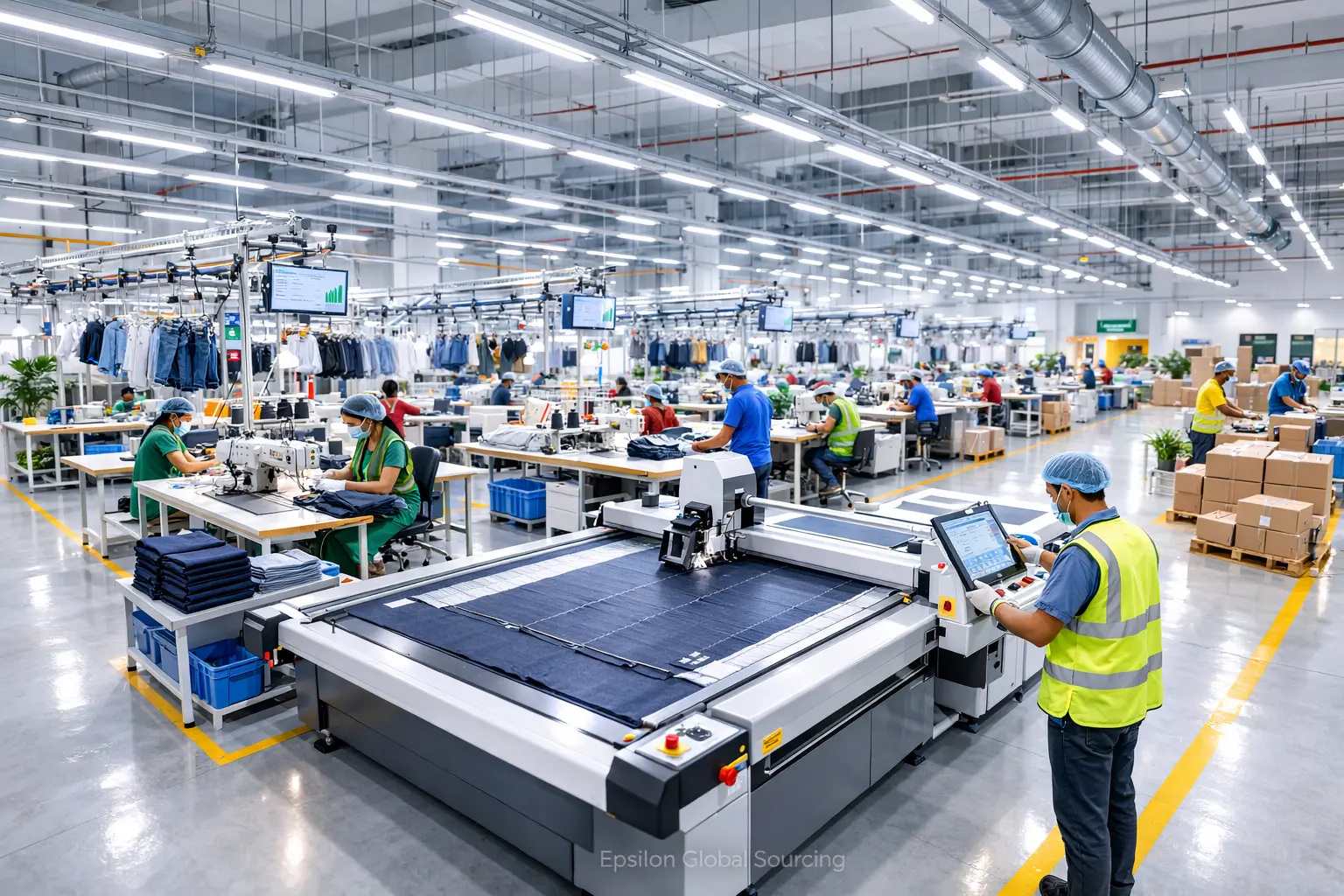
Executive Summary
Bangladesh’s Ready-Made Garment (RMG) sector in 2026 bears little resemblance to the outdated perception of a low-cost, basics-only sourcing hub.
For UK, EU, and US brands, the competitive advantage of sourcing in Bangladesh is no longer defined solely by labor arbitrage. It is defined by systemic capability. The country & the clothing manufacturers in Bangladesh have undergone a structural transformation across industrial scale, safety governance, sustainability, and vertical integration.
The opportunity is real. The complexity is structural. Governance determines the outcome.
TL;DR — Key Takeaways for Sourcing Executives:
Beyond Basics: Bangladesh now manufactures complex outerwear, activewear, and engineered denim at scale.
Sustainability Leadership: The country hosts the highest number of LEED-certified green garment factories worldwide, signaling deep ESG maturity.
Vertical Integration: Local spinning, knitting, dyeing, and trim ecosystems drastically reduce dependency on imported raw materials and improve lead-time control.
Structural Cost Competitiveness: Efficiency-driven SMV (Standard Minute Value) optimization and scale dilution protect FOB margins, particularly for volume programs.
Favorable Trade Dynamics: Preferential market access for UK and EU brands materially improves Landed Duty Paid (LDP) calculations.
Infrastructure Upgrades: Port modernization and Matarbari deep-sea access are reducing historical congestion and improving logistics predictability.
The Governance Mandate: Risk is now governance-driven, not geography-driven. Direct-to-factory sourcing without structured oversight increases exposure to quality fade and compliance failures.
For decision-makers evaluating global sourcing allocation in 2026, the question is no longer whether Bangladesh is capable. The question is whether your sourcing governance is structured enough to fully leverage it.
Table of contents
ShowHide- The Evolution of Bangladesh’s RMG Sector: Beyond the Stereotypes
- Unmatched Scale and Production Capacity
- Cost Competitiveness in 2026: Why It Still Wins
- Labor Costs vs. Operator Efficiency
- Trade Structures and Landed Cost Dynamics Across the UK, EU and US
- The 2026 Cost Equation
- The Green Revolution: Leading the World in Sustainable Garment Sourcing & Manufacturing
- Infrastructure Upgrades and Shrinking Lead Times
- Strategic Implication for Global Buyers
- Navigating the Complexities: Why You Need a Sourcing Partner
- How a London-Based Sourcing Office Bridges the Gap
- The Strategic Conclusion
The Evolution of Bangladesh’s RMG Sector: Beyond the Stereotypes
For more than two decades, Bangladesh’s Ready-Made Garment (RMG) sector has been viewed through a narrow lens: low-cost, high-volume, basic apparel production. That perception is outdated.
In 2026, Bangladesh apparel sourcing represents a structurally evolved, compliance-driven, and technically capable manufacturing ecosystem that competes not only on price but increasingly on engineering capability, production scale, vertical integration, and governance discipline.
To understand why Bangladesh remains one of the strongest large volume garment sourcing destinations globally, decision-makers must separate legacy narratives from operational reality.
From Fast Fashion Basics to Value-Added Garments
Historically, Bangladesh built its export dominance on high-volume basics:
T-shirts
Polo shirts
Lightweight woven bottoms
Basic fleece
Entry-level knitwear
This specialization was not accidental. It was a strategic response to global fast-fashion demand in the 2000s and early 2010s. The country optimized for:
Labor-intensive production
Economies of scale
Lean manufacturing efficiencies
Aggressive FOB pricing
However, the past decade has seen a decisive shift.
By 2026, the competitive landscape has matured. Bangladesh is no longer just a “basics factory.” The industry has expanded significantly into value-added categories, including:
Technical outerwear
Performance and athleisure garments
Structured tailoring
Denim with advanced wash technologies
Seam-sealed and bonded products
Complex knit constructions
This transition was driven by three forces:
Buyer consolidation pressure: Global brands reduced supplier bases and demanded multi-category capability.
Margin compression in basics: Factories were forced to move up the value chain.
Capital reinvestment: Leading groups invested heavily in machinery, design capability, and vertical integration.
Today, major Bangladeshi manufacturing groups operate:
In-house fabric mills
Washing and finishing plants
Technical labs
Automated cutting systems
ERP-controlled production floors
The result is a shift from pure volume-driven production to engineering-led apparel manufacturing sourcing.
“Bangladesh is no longer competing solely on labor arbitrage. It is competing on production architecture and execution control.”
Buyers who still associate the country only with entry-level fast fashion are operating with an outdated sourcing thesis.
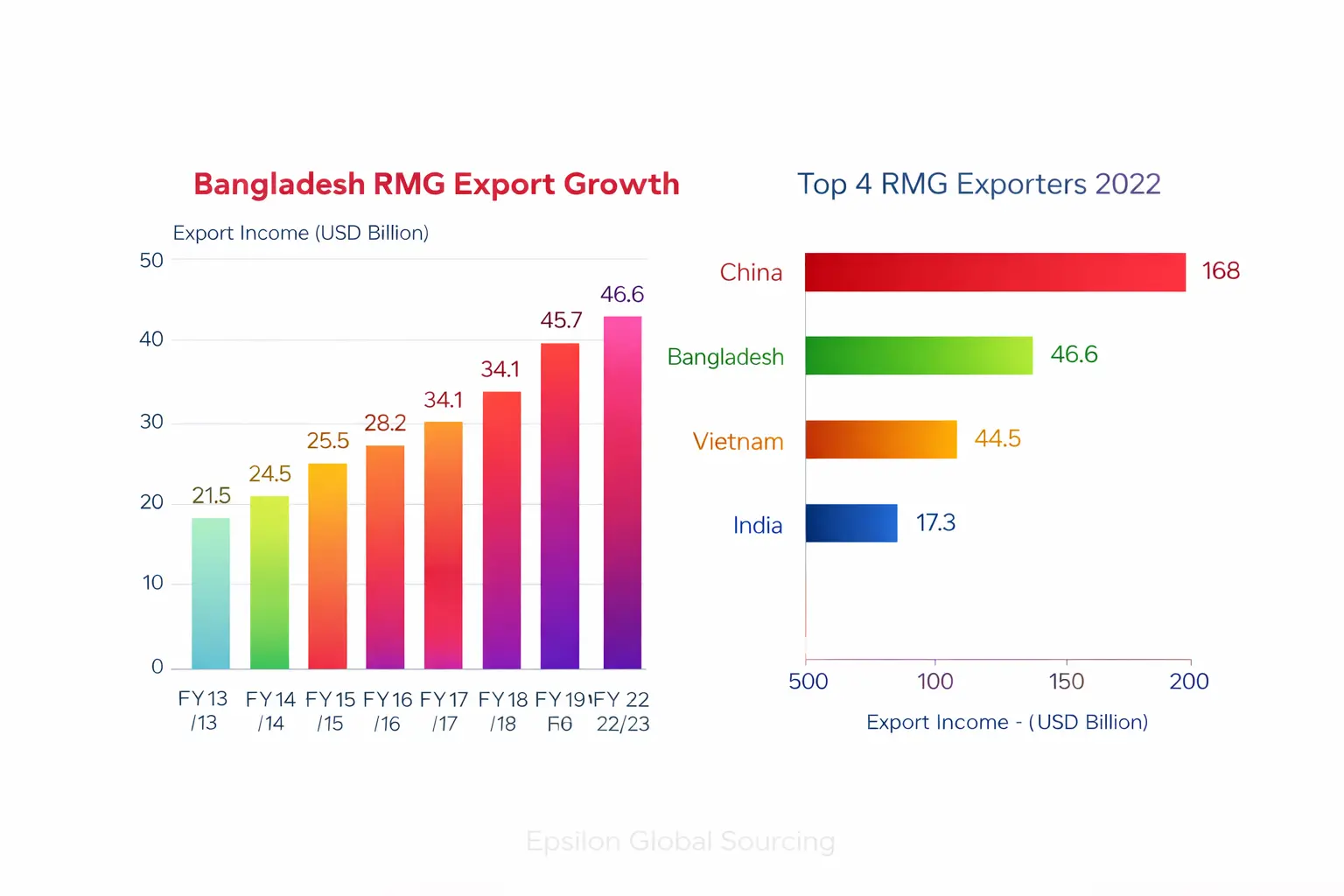
Data chart illustrating the rapid export growth and scale of the Bangladesh Ready-Made Garment (RMG) sector.
The Post-Rana Plaza Safety Revolution
No analysis of Bangladesh apparel manufacturing is credible without directly addressing the 2013 Rana Plaza collapse. It was a structural shock that reshaped the global sourcing industry.
The critical question for 2026 is not what happened in 2013.
The real question is: What changed afterward?
The answer is significant.
Following the tragedy, two unprecedented compliance initiatives were implemented:
Accord on Fire and Building Safety in Bangladesh
Alliance for Bangladesh Worker Safety
These programs introduced:
Mandatory structural inspections
Fire safety remediation requirements
Electrical safety upgrades
Transparent reporting mechanisms
Strict corrective action timelines
Thousands of factories underwent structural, fire, and electrical audits. Non-compliant units were suspended or permanently closed. Billions of dollars were invested in remediation.
The result is an uncomfortable but factual reality:
Bangladesh is now one of the most heavily audited apparel sourcing destinations in the world.
In many cases, factory compliance visibility in Bangladesh exceeds that of:
Emerging African sourcing hubs
Smaller South Asian competitors
Certain Southeast Asian clusters
This transformation also changed buyer behavior. Today, global brands operating in Bangladesh typically require:
SMETA audits
BSCI compliance
Structural certifications
Third-party fire approvals
Digital production transparency
The compliance infrastructure has become institutionalized rather than reactive.
“The post-2013 regulatory architecture did not simply repair buildings. It rebuilt the governance model of the industry.”
For sourcing executives, this matters.
Risk mitigation is no longer optional. It is embedded into the ecosystem.
In summary, the evolution of Bangladesh’s RMG sector is not cosmetic. It is structural. The country has transitioned from a volume-centric basics hub to a compliance-intensive, increasingly technical, and globally integrated manufacturing platform.
The stereotype has expired.
The opportunity, however, has not.
Contact us to discuss apparel sourcing requirements in Bangladesh.
Our team provides factory matching, costing transparency, compliance oversight, and end to end production management.
Unmatched Scale and Production Capacity
For any serious sourcing executive, one question overrides all marketing narratives:
Can they handle my volume without operational instability?
In 2026, Bangladesh’s answer is unequivocal.
The country is not merely a manufacturing location. It is a mass-scale production ecosystem engineered for industrial output at a level that few sourcing destinations can replicate. Scale is not incidental. It is structural.
Bangladesh’s RMG sector now operates as a dense industrial cluster with:
Thousands of export-oriented factories
Concentrated labor pools with category specialization
Embedded compliance infrastructure
Mature port logistics through Chattogram and inland depots
Institutionalized buyer coordination systems
The implication for brands is straightforward:
"Bangladesh is one of the very few countries capable of absorbing large-volume apparel programs while maintaining price competitiveness and delivery predictability."
The Core Strengths: Denim, Cotton, and Knitwear
Bangladesh’s global dominance is not evenly distributed across all categories. It is strongest where industrial depth meets technical repetition.
1. Denim
Bangladesh has become one of the world’s largest exporters of denim garments. The sector benefits from:
Industrial-scale washing plants
Advanced laser and ozone finishing technologies
Sustainable water-reduction processes
High-capacity cutting and stitching lines
Major international brands rely on Bangladesh for:
Core five-pocket denim
Stretch denim programs
Fashion washes
Mid-range premium positioning
The country’s advantage lies in its ability to produce denim at scale while managing wash complexity and cost efficiency.
2. Cotton-Based Apparel
Bangladesh’s specialization in cotton garments is historically rooted but technologically upgraded.
Strength factors include:
Skilled workforce in cotton knits and woven bottoms
High-efficiency sewing lines optimized for repetition
Deep supplier familiarity with global cotton sourcing patterns
For buyers running large cotton-based programs such as:
T-shirts
Polo shirts
Sweatshirts
Basic woven trousers
Bangladesh remains one of the most commercially viable sourcing platforms in the world.
3. Knitwear Dominance
Bangladesh’s knitwear cluster is particularly formidable.
The ecosystem includes:
Circular knitting mills
Rib and collar producers
Dyeing and finishing plants
Printing and embroidery facilities
This concentration allows for:
Faster fabric replenishment
Reduced MOQ constraints
Strong cost engineering
High-volume repeat programs
“When evaluating sourcing destinations, category specialization matters more than headline export figures. Bangladesh’s knit and denim clusters are industrially mature, not experimental.”
The Rise of Vertical Integration
Historically, one criticism of Bangladesh sourcing was dependence on imported raw materials, particularly from China. Lead times were therefore partially exposed to upstream supply chain volatility.
That dynamic has materially shifted.
Over the past decade, Bangladesh has invested heavily in vertical integration, particularly in:
Local spinning mills
Knitting mills
Dyeing and finishing plants
Trim and accessories production
The objective has been clear:
Reduce reliance on imported raw materials and compress total lead time.
The results are visible in three areas.
1. Lead Time Compression
For cotton knit programs, factories can now source:
Yarn locally
Fabric domestically
Trims within the country
This reduces:
Import dependency delays
Customs exposure
Transit buffer requirements
In practical terms, this allows for:
Faster repeat orders
More agile in-season replenishment
Reduced working capital tied up in pipeline inventory
2. Cost Stability
Local sourcing of yarn and trims reduces:
Currency fluctuation exposure
Freight volatility
External geopolitical dependency
This creates stronger cost predictability for FOB programs.
3. Greater Production Control
Vertical integration also improves:
Fabric quality monitoring
Shade consistency
Batch traceability
Production planning synchronization
When fabric and garment production operate within aligned ownership groups, execution discipline improves.
“Vertical integration does not eliminate supply chain risk. It redistributes control. In Bangladesh’s case, it has shifted meaningful control back inside the domestic ecosystem.”
In summary, Bangladesh’s scale is not theoretical. It is operational.
Its strength in denim, cotton, and knitwear, combined with expanding vertical integration, positions it as one of the few sourcing destinations capable of absorbing serious volume while maintaining commercial competitiveness.
For brands asking whether Bangladesh can handle large programs, the more relevant question in 2026 is:
Can your sourcing governance handle Bangladesh’s scale effectively?
Contact us to discuss apparel sourcing requirements in Bangladesh.
Our team provides factory matching, costing transparency, compliance oversight, and end to end production management.
Cost Competitiveness in 2026: Why It Still Wins
Cost remains the dominant variable in global apparel sourcing decisions. Procurement teams benchmark FOB. CFOs model landed margins. Boards assess sourcing shifts through the lens of geopolitical exposure and total cost architecture.
The persistent question in 2026 is direct:
Is Bangladesh still cost competitive, or has the wage gap closed?
The answer requires nuance.
Bangladesh does not win purely because labor is inexpensive. It wins because of a structural combination of:
Labor architecture
Operator productivity
Scale-driven overhead dilution
Vertical integration
Trade positioning
Total Landed Duty Paid (LDP) dynamics
Buyers who evaluate only headline wage rates misunderstand the sourcing equation.
Labor Costs vs. Operator Efficiency
For years, Bangladesh was labeled a “low-wage sourcing hub.” That framing is strategically incomplete.
While wage levels remain competitive relative to many Asian peers, cost advantage in 2026 is less about wage arithmetic and more about Standard Minute Value (SMV) optimization.
Modern Bangladeshi factories increasingly operate with:
Automated cutting systems
Real-time production tracking platforms
Dedicated industrial engineering departments
Lean production specialists
Precision line balancing
The outcome is measurable:
Higher operator output per hour
Reduced idle time
Lower rework ratios
Improved line efficiency percentages
In practical terms, even where nominal wages increase, the cost per garment unit remains competitive because productivity per operator improves.
“Sourcing cost is a function of efficiency, not wage level.”
Skilled operators in mature Bangladeshi clusters demonstrate high repetition speed and stability in:
Knitwear programs
High-volume denim lines
Structured woven basics
Factory groups investing in automation also achieve:
Improved marker efficiency
Reduced fabric wastage
Lower defect ratios
More predictable SMV calculations
These factors reduce hidden cost drivers that erode FOB competitiveness elsewhere.
Trade Structures and Landed Cost Dynamics Across the UK, EU and US
Beyond factory-level economics, Bangladesh’s most powerful competitive lever lies in trade architecture.
UK and EU Markets
Bangladesh benefits from preferential market access into Europe.
Access to the European market has historically been facilitated under the European Union Generalised Scheme of Preferences framework.
Following Brexit, Bangladesh continues to benefit from preferential access into the UK under the UK Generalised Scheme of Preferences implemented by the Government of the United Kingdom.
The financial implications are material.
Duty-free or reduced-duty treatment results in:
Lower import tariffs into EU and UK markets
Improved gross margins
Enhanced landed cost predictability
For buyers calculating Landed Duty Paid (LDP) cost, the equation includes:
FOB price
Freight
Insurance
Customs clearance
Import duties
Where duty is zero or materially reduced, Bangladesh’s competitive position strengthens immediately.
In comparison, sourcing from countries without preferential access can add:
8 to 12 percent duty exposure in certain categories
Direct margin compression
Retail price pressure
“The sourcing decision is not made at FOB. It is made at LDP.”
For high-street and price-sensitive segments in Europe, a few percentage points in duty differential can determine category viability.
The US Landed Cost Equation
The United States operates under a different tariff framework. Bangladesh does not benefit from broad preferential access into the US in the same manner as in the EU or UK.
This alters the duty structure, but it does not eliminate competitiveness.
For US brands, landed cost must account for:
FOB price
Ocean freight
Insurance
Import duties
Inland US logistics
Even where duties apply, Bangladesh frequently remains competitive due to:
Structurally efficient FOB pricing
Scale-driven overhead dilution
SMV-optimized production
Vertical integration reducing upstream volatility
In high-volume categories such as:
Cotton knit basics
Core denim
Entry-level woven bottoms
Bangladesh continues to serve as a margin-efficient production base for US brands.
“For US buyers, Bangladesh’s advantage lies less in tariff arbitrage and more in scale efficiency and cost engineering.”
While nearshore sourcing may serve ultra-fast replenishment cycles, Bangladesh remains commercially rational for volume-driven seasonal programs.
The 2026 Cost Equation
Bangladesh wins on cost not because it is universally the cheapest, but because it integrates:
Competitive labor architecture
Increasing operator productivity
Scaled industrial output
Vertical integration
Preferential access in Europe
Scale-driven margin efficiency for US programs
When evaluated at the Landed Duty Paid level, Bangladesh remains one of the most financially efficient sourcing destinations for UK and EU brands and continues to deliver commercially compelling economics for US volume categories.
Cost competitiveness in 2026 is not accidental. It is the result of layered structural advantages developed over decades.
For brands seeking margin protection in volatile retail environments across London, Berlin, or New York, Bangladesh remains a strategically rational anchor within a diversified global sourcing portfolio.
Contact us to discuss apparel sourcing requirements in Bangladesh.
Our team provides factory matching, costing transparency, compliance oversight, and end to end production management.
The Green Revolution: Leading the World in Sustainable Garment Sourcing & Manufacturing
If cost and scale answer the procurement question, sustainability answers the boardroom question.
In 2026, ESG performance is no longer a marketing narrative. It is embedded into:
Retailer risk assessments
Investor scrutiny
Regulatory compliance frameworks
Consumer brand positioning
For global fashion brands, sourcing decisions are now evaluated not only by margin contribution but by environmental footprint, social governance, and supply chain transparency.
Bangladesh’s transformation in this domain is one of the most underappreciated shifts in global apparel manufacturing.
The Highest Number of LEED-Certified Factories Globally
Bangladesh currently holds the highest number of LEED-certified garment factories in the world, certified under the U.S. Green Building Council framework.
U.S. Green Building Council administers the globally recognized LEED standard. Certification requires measurable compliance across:
Energy efficiency
Water conservation
Indoor environmental quality
Sustainable material use
Waste reduction
Bangladesh does not merely participate in LEED certification. It leads it.
The country hosts:
Dozens of Platinum-rated facilities
Numerous Gold-rated factories
Large-scale green industrial complexes purpose-built for sustainability
This development is strategic, not cosmetic.
Leading Bangladeshi manufacturing groups have invested in:
Solar energy installations
Natural daylight optimization in factory floors
Rainwater harvesting systems
Low-energy dyeing machinery
Advanced insulation and ventilation systems
The financial logic is compelling:
Lower long-term operating costs
Reduced energy dependency
Stronger positioning with ESG-focused buyers
Improved workforce retention through better working environments
“In sustainability benchmarking, Bangladesh is no longer catching up. In green-certified garment factories, it is setting the pace.”
For brands under pressure from investors and regulators, sourcing from LEED-certified facilities provides measurable ESG reporting leverage.

Exterior of a LEED-certified green garment factory in Dhaka, Bangladesh, featuring solar panels and sustainable architecture.
Water Treatment (ETP) and Circular Fashion Initiatives
Environmental risk in apparel manufacturing is most visible in water usage and chemical discharge.
Bangladesh’s regulatory and industry evolution has focused heavily on:
Effluent Treatment Plants (ETPs)
Wastewater recycling
Zero liquid discharge processes
Chemical management systems
Modern dyeing and washing facilities in Bangladesh increasingly operate with:
In-house ETP systems
Real-time water monitoring
Sludge management controls
Compliance with international wastewater discharge standards
Factories that previously discharged untreated wastewater are no longer part of compliant export supply chains.
This shift is reinforced by buyer audit regimes and international compliance programs.
amfori and Sedex frameworks further strengthen environmental governance through structured auditing.
Circular Materials and Recycled Inputs
Bangladesh is also scaling capability in:
Recycled polyester (rPET) production
Organic cotton sourcing
Regenerated fiber blends
Waste fabric recycling initiatives
Vertical integration has enabled garment groups to:
Incorporate recycled yarn into knit programs
Develop certified organic cotton collections
Offer traceability documentation
Reduce raw material waste
Global fashion brands are increasingly allocating sustainable capsule collections to Bangladesh due to:
Cost-effective recycled fiber production
Availability of certified mills
Alignment with ESG disclosure requirements
“Circular fashion is no longer experimental in Bangladesh. It is commercially deployable at scale.”
Strategic Implication for 2026
Bangladesh’s sustainability leadership is not accidental. It emerged from:
Post-crisis compliance restructuring
Buyer-driven audit intensity
Capital reinvestment by major factory groups
Regulatory alignment with global environmental standards
For brands operating in ESG-sensitive markets such as the UK and EU, Bangladesh offers:
Measurable green building credentials
Structured water treatment systems
Scalable circular production
Governance transparency
In 2026, sustainability is not a secondary consideration in apparel sourcing. It is a primary screening variable.
Bangladesh has positioned itself not as a low-cost polluter, but as a scaled, ESG-aligned manufacturing ecosystem capable of meeting the environmental expectations of modern global fashion brands.
Contact us to discuss apparel sourcing requirements in Bangladesh.
Our team provides factory matching, costing transparency, compliance oversight, and end to end production management.
Infrastructure Upgrades and Shrinking Lead Times
If cost is predictable and compliance is controlled, the final sourcing variable is time.
For UK, EU, and US buyers alike, logistics risk can outweigh production risk. Late shipments trigger:
Retail markdown exposure
Missed promotional windows
Air freight escalation
Working capital distortion
Inventory imbalance across distribution centers
Historically, Bangladesh faced criticism around port congestion and shipment delays. In 2026, that narrative requires reassessment.
The country has invested aggressively in port modernization, inland connectivity, and deep-sea access, materially improving export reliability for both transatlantic and transpacific routes.
Port Innovations and Deep Sea Access
Bangladesh’s primary export gateway is the Port of Chittagong, now widely referred to as Chattogram Port.
Over the past decade, the port has undergone structural upgrades including:
Expanded container handling capacity
Modernized terminal equipment
Improved digital customs clearance systems
Increased yard optimization
Extended operational throughput efficiency
Container performance has strengthened through:
Reduced dwell times
Streamlined customs digitization
Expanded use of private inland container depots supporting pre-clearance
The second structural shift lies in the development of the Matarbari Deep Sea Port.
Matarbari is strategically significant because it:
Enables handling of larger mother vessels
Reduces reliance on feeder transshipment via Singapore or Colombo
Shortens maritime transit cycles
Lowers congestion dependency
For UK and EU buyers, this translates into:
Improved sailing frequency
Greater vessel schedule predictability
Reduced production planning buffers
For US buyers, the implications are equally important:
More stable East Coast and West Coast routing
Improved container allocation reliability
Reduced exposure to cascading feeder delays
“Lead time is no longer purely a factory variable. It is an infrastructure variable. Bangladesh has begun addressing both.”
In parallel, road connectivity between major industrial clusters such as Gazipur and Narayanganj and the port corridors has improved, reducing inland transit volatility before export departure.
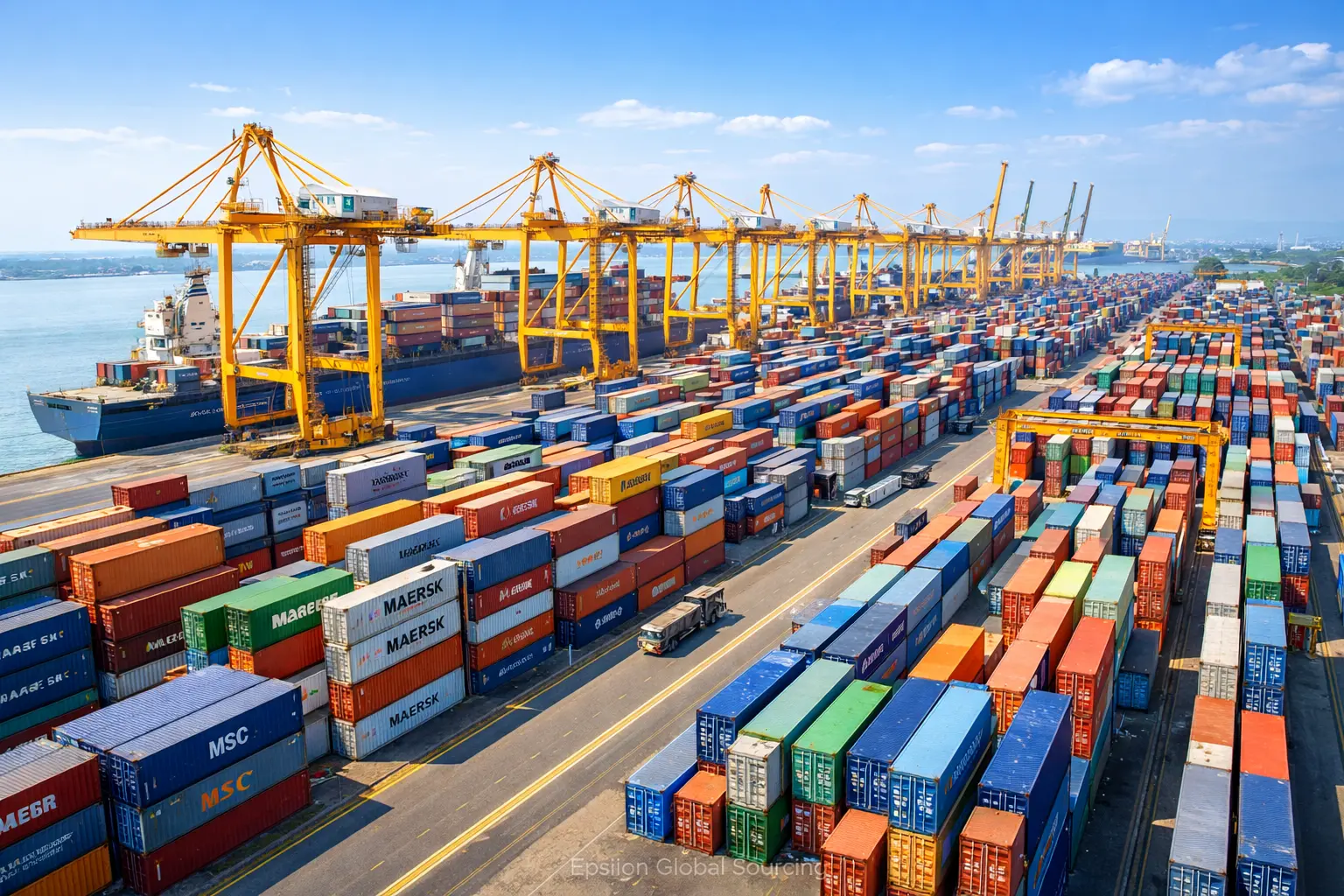
Cargo containers and shipping cranes at Chittagong Port, handling global apparel exports from Bangladesh.
Realistic Production Calendars for UK, EU & US Brands
Infrastructure improvements are only relevant if they translate into realistic delivery timelines.
In 2026, for established, compliant factories with confirmed fabric availability, a practical production calendar appears as follows.
Sample Timeline: 60 to 90 Days from PO to Shipment
Day 0–7: Order Confirmation & Pre-Production
Purchase Order issuance
Tech pack finalization
Fabric booking confirmation
Trim approvals
Day 10–30: Fabric Production
Yarn sourcing or allocation
Knitting or weaving
Dyeing and finishing
Lab dips and bulk shade approval
Day 30–60: Garment Manufacturing
Cutting
Sewing
Inline quality control
Finishing and packing
Day 60–75: Final Inspection & Port Movement
AQL inspection
Carton consolidation
Inland transfer to port
Day 75–90: Vessel Departure
Container loading
Export clearance
Shipment departure
Transit Profiles by Region
UK & EU
Transit time to major European ports typically ranges between:
18 to 30 days depending on routing
Shorter where direct services are available
For repeat programs with pre-booked fabric, production can compress closer to:
45 to 60 production days
United States
For US buyers, the total sourcing calendar must incorporate longer sea transit.
Typical ocean freight ranges:
East Coast ports such as New York or Savannah: 28 to 40 days
West Coast ports such as Los Angeles or Long Beach: 32 to 45 days depending on routing
A realistic PO-to-US-port arrival cycle generally falls within:
90 to 120 days total
For replenishment programs with committed fabric and stable capacity:
60 to 75 days ex-factory
30 to 40 days transit
“The difference between a 60-day and 90-day production cycle is rarely factory incompetence. It is planning discipline.”
“For US buyers, Bangladesh is not primarily a speed strategy. It is a scale and margin strategy.”
Contact us to discuss apparel sourcing requirements in Bangladesh.
Our team provides factory matching, costing transparency, compliance oversight, and end to end production management.
Navigating the Complexities: Why You Need a Sourcing Partner
Bangladesh in 2026 offers scale, cost competitiveness, sustainability leadership, and modernizing infrastructure.
However, sourcing success is not determined by geography alone.
It is determined by governance architecture.
The difference between a profitable sourcing program and a margin-eroding one rarely lies in factory capability. It lies in:
Supplier selection discipline
Production control systems
Contract enforceability
Real-time problem resolution
Cross-border coordination maturity
The strategic error many UK, EU, and US brands make is assuming that strong factories eliminate sourcing risk.
They do not.
They reduce production risk. Commercial and operational risk remain.
Bangladesh rewards structured sourcing strategies.
It penalizes transactional ones.
The Hidden Costs of Direct-to-Factory Sourcing
On paper, direct sourcing appears rational. Remove the intermediary. Negotiate sharper FOB. Communicate directly with the factory.
In practice, this frequently creates an Iceberg Cost Structure.
Visible Cost:
Lower quoted FOB
Hidden Costs Below the Surface:
Communication delays
Misinterpreted tech packs
Quality fade across bulk production
Unapproved subcontracting
Rework and air freight escalation
Compliance exposure
Cultural and time-zone misalignment
Import documentation risk for US buyers
“The FOB price is visible. Execution risk is not.”
1. Communication Delays
Time-zone separation between Bangladesh and Western markets introduces structural friction.
For UK and EU brands, misalignment can create 24-hour response cycles.
For US brands, particularly West Coast teams, the gap can extend further.
This affects:
Sample correction cycles
Fabric shade approvals
Label compliance queries
Packaging confirmations
Import documentation clarification
Small delays compound into production drift.
2. Unapproved Subcontracting
During peak season capacity pressure, factories may outsource portions of production without explicit buyer visibility.
Without on-ground monitoring, brands risk:
Social compliance violations
Inconsistent workmanship
Audit exposure
US customs scrutiny under stricter import enforcement frameworks
Subcontracting risk is not theoretical. It is structural when oversight is weak.
3. Quality Fade
Quality fade occurs when:
Initial samples are carefully supervised
Bulk production oversight weakens
Inline supervision becomes reactive rather than preventive
The outcome:
Higher defect ratios
Carton-level rejections
Increased returns in retail markets
Margin erosion
Attempting to save 2 to 3 percent at FOB can create 8 to 12 percent margin loss at retail.
This is equally true for:
UK high-street brands
EU multi-brand distributors
US department store suppliers
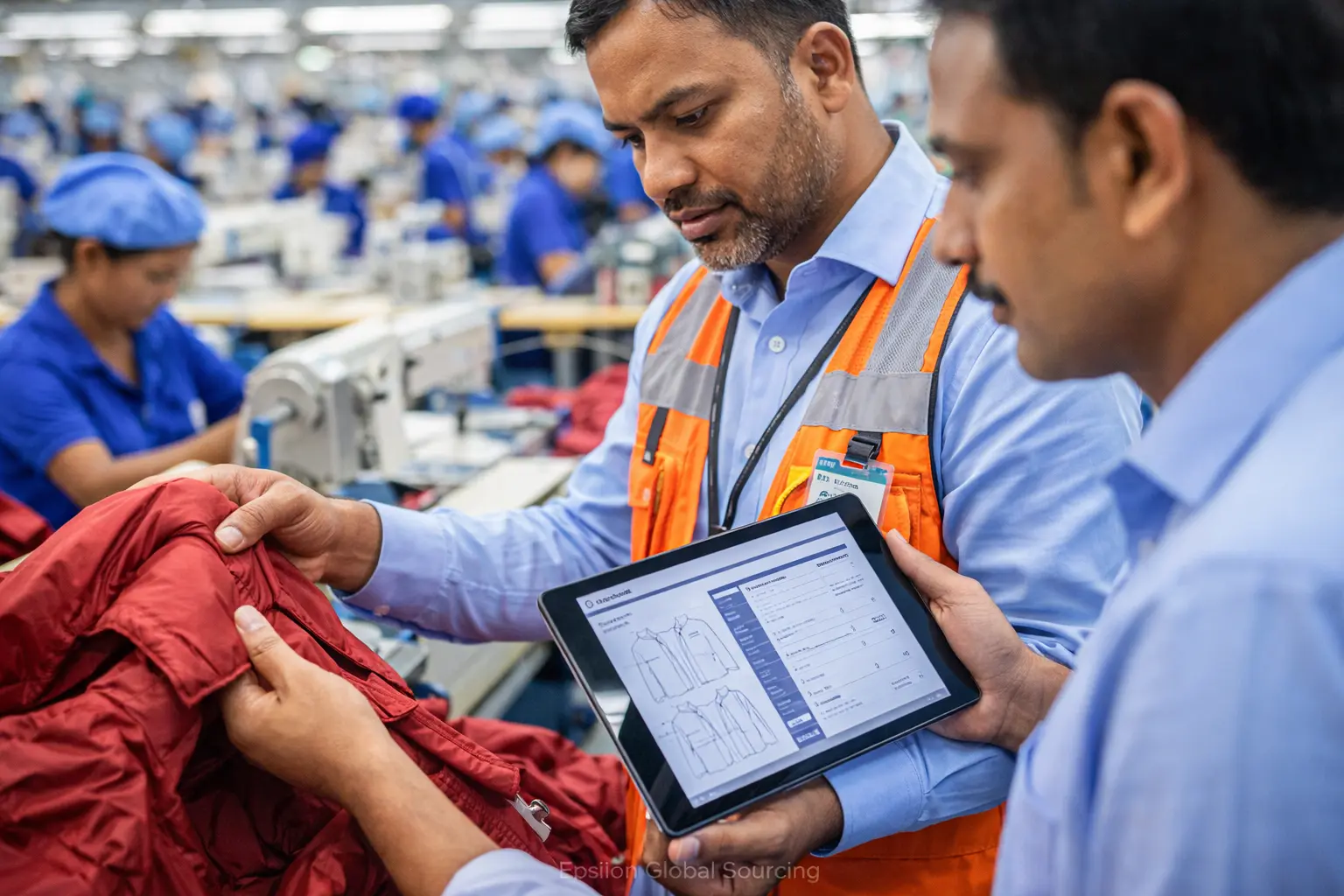
An Epsilon GS apparel sourcing agent conducting a rigorous quality control inspection inside a Bangladesh manufacturing facility.
How a London-Based Sourcing Office Bridges the Gap
A sophisticated sourcing partner does not replace the factory.
It governs the interface between brand and manufacturer.
For UK, EU, and US brands, a London-headquartered sourcing office with operational presence in Dhaka creates structural advantages.
1. UK-Enforceable Commercial Framework
Contracts governed under UK jurisdiction provide:
Clear dispute resolution pathways
Structured commercial accountability
Reduced contractual ambiguity
Defined liability parameters
For US brands, this also offers:
Western commercial alignment
Transparent financial governance
Legal clarity beyond purely offshore agreements
This creates buyer-side confidence that purely direct offshore arrangements cannot replicate.
2. On-Ground Teams in Dhaka
Effective sourcing requires physical presence.
An integrated model includes:
Dedicated QC inspectors in Dhaka
Inline production monitoring
Pre-shipment AQL inspections
Real-time escalation to factory leadership
This eliminates blind spots between:
Approved samples
Inline bulk output
Final shipment readiness
“Sourcing without physical oversight is delegation without control.”
For US buyers operating across multiple time zones, this local presence prevents problems from escalating overnight.
3. Real-Time Cross-Atlantic Problem Solving
Time-zone lag is operational risk.
A London-based commercial office aligned with Western business hours ensures:
Immediate response to buyer concerns
Rapid commercial clarification
Faster approval loops
Escalation without 24-hour delay cycles
Simultaneously, Bangladesh-based teams manage:
Factory floor execution
Compliance verification
Capacity constraints
Corrective action implementation
For US brands, this dual-layer structure provides:
Western-facing commercial coordination
Local production control
Reduced import documentation errors
Stronger oversight of labeling and regulatory compliance
The communication gap collapses.
4. Supplier Governance and Selection Discipline
The greatest risk in Bangladesh is not the country.
It is supplier misalignment.
An experienced sourcing partner:
Pre-screens factory groups
Audits technical capability beyond marketing claims
Evaluates vertical integration depth
Assesses real capacity versus declared capacity
Monitors subcontracting exposure
Reviews ESG compliance consistency
This governance layer protects:
UK brands from reputational exposure
EU brands from regulatory non-compliance
US brands from import enforcement and customs risk
The Strategic Conclusion
Bangladesh in 2026 is one of the most structurally competitive apparel sourcing destinations in the world.
Its advantages are no longer limited to labor cost. They now include:
Industrial scale
Category specialization
Vertical integration
Sustainability leadership
Infrastructure modernization
However, structural strength does not guarantee commercial outcomes.
Without disciplined governance, brands expose themselves to:
Margin erosion
Compliance exposure
Production volatility
Reputational risk
With structured sourcing architecture, including Western commercial oversight, on-ground execution control, and intelligent supplier governance, Bangladesh shifts from being merely cost-effective to being strategically resilient.
The critical mistake in modern sourcing strategy is binary thinking.
It is not Bangladesh versus nearshore.
It is not cost versus speed.
It is not scale versus compliance.
It is portfolio design.
For brands serving London, Berlin, or New York, Bangladesh functions best as a margin-anchoring, volume-capable production base within a globally diversified sourcing framework.
The opportunity is real.
The complexity is permanent.
The competitive advantage belongs to brands that combine scale access with professional sourcing governance.
Frequently Asked Questions About Sourcing from Bangladesh
If your brand is seeking a reliable apparel sourcing partner with access to Tier 1 and mid-tier factories in Bangladesh, Epsilon Global Sourcing provides:
- End to end apparel sourcing service
- Factory capability matching
- Transparent costing breakdown
- Compliance and audit oversight
- Multi stage quality control
- LC and documentation handling
- Production tracking and reporting
Contact us to discuss your sourcing needs and strengthen your supply chain with a high performing Bangladesh apparel sourcing team.